Project
Rashid Johnson's Anxious Men Wallpaper at The Drawing Center
How we printed the wallpaper for Rashid Johnson: Anxious Men at The Drawing Center in SoHo, a photograph of the artist's father repeated around the gallery, and went on to print wallpaper as Johnson's creative medium.
 By Joseph A. Gornail

Rashid Johnson approached us with an idea to make wallpaper a central feature of his exhibitions.
He was the first of our clients to treat wallpaper as a creative medium in its own right. For several consecutive years, his studio sent us high-resolution images, sometimes nature scenes, sometimes African masks, sometimes book covers, and Johnson used the printed results to build immersive spaces around his work. It started in 2015, at The Drawing Center in SoHo, with a photograph of his father.
The Exhibition
Rashid Johnson: Anxious Men ran from October 2 to December 20, 2015 in The Drawing Center’s Drawing Room gallery, curated by Senior Curator Claire Gilman. At its core was a new series Johnson called his “anxious men”: portraits made in black soap and wax on white ceramic tile, drawn by digging into the waxy surface, and the first time he had worked figuratively outside of photography or film.
The Drawing Center describes the portraits as set within a multi-sensory environment: a soundtrack of Melvin Van Peebles’s “Love, That’s America,” and wallpaper featuring a photograph of the artist’s father from the year Johnson was born.

Opening night: the tile portraits hung directly on the wallpaper.
The Photograph
The image is Johnson’s father in a white karate gi with a green belt, seated cross-legged in front of a bookshelf. Johnson’s studio supplied it as a high-resolution file, and the wallpaper mirrors it into a repeat: the figure flips left and right, row after row, until the photograph becomes a pattern of white gis, green belts and warm red-brown bands.

Up close you see a father in a family photo. From across the room you see stripes. The repeat works at both distances, and that double reading is a large part of what made the room feel immersive rather than decorated.
Project Specifications
- Client: Rashid Johnson Studio, for Rashid Johnson: Anxious Men at The Drawing Center
- Artwork: high-resolution photograph supplied by the artist’s studio
- Material: self-adhesive matte vinyl
- Coverage: the walls of the Drawing Room gallery
- Installation: The Drawing Center’s own crew
- Our contact: Alex Ernst, Studio Manager, Rashid Johnson Studio
Printing the Repeat
For a mirrored repeat, the reflections have to line up across every seam, or the pattern breaks and the eye goes straight to the join. We printed the panels to the same repeat, so each one picks up exactly where the last one leaves off.

On press: the repeat coming off the printer.
The matte finish keeps a photographic print readable under gallery spotlights, without the glare a gloss vinyl would throw back at visitors.

The Installation
The Drawing Center’s crew hung the wallpaper. They started by measuring the bare walls of the Drawing Room, with the printed rolls waiting on the protected floor.

Panels were trimmed by hand against a straightedge, so each edge met its neighbor cleanly at the seam.

Because the vinyl is self-adhesive, there was no paste: the crew worked from scaffolding, peeling back the liner and smoothing each panel down from the top of the wall.
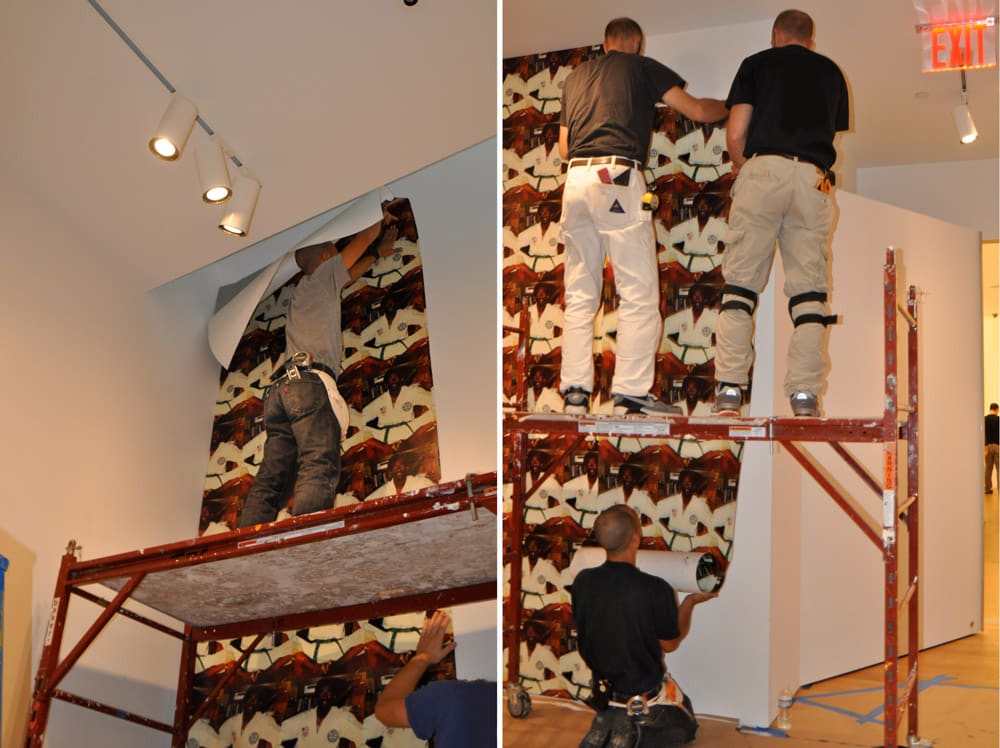
Liner off, panel down: self-adhesive vinyl going up from the scaffolding.
Wallpaper as an Artist’s Medium
Anxious Men was the beginning. Over the next few years, Johnson used our wallpaper as part of his practice, sending images, nature scenes, African masks, book covers, and building spaces with the prints. His studio went on to introduce us to other institutions like Hauser & Wirth, eventually opening up opportunities to print for museums like the Whitney.
Custom wallpaper even made its way into the paintings themselves. In his Escape Collage series, shown in Rashid Johnson: Hail We Now Sing Joy at the Milwaukee Art Museum in 2017, Johnson collaged vividly colored custom wallpaper of tropical images over ceramic tile, then marked it with spray paint and coated it in black soap and wax.
Few clients have pushed what wallpaper can be as far as Johnson did: not a backdrop for the art, but one of the materials it’s made from.
What This Project Taught Us
- Wallpaper can be the artwork. In the right hands, it’s a medium, not a finish.
- Mirrored repeats need perfect seams. Every reflection has to line up, panel to panel.
- Matte suits a gallery. A flat finish keeps a photographic print readable under spotlights and lets the art on top stand out.
- Self-adhesive speeds up an install. No paste, no booking time: a gallery crew can hang it between shows.
- Good partnerships compound. One exhibition became years of work with the same studio.
Questions We Hear From Artists
Can you turn my photograph into wallpaper? Yes. Send the highest-resolution file you have; at least 300 dpi at final print size is ideal. We can print it as a mural, or repeat or mirror it into a pattern, and we’ll send a printed proof before production.
Can I use wallpaper as material in my own artwork? Yes. Artists use our prints for installations, collage and mixed media. See our page for artists.
What’s the difference between self-adhesive and traditional wallpaper for a gallery? Self-adhesive vinyl goes up without paste, which suits fast exhibition turnarounds. Traditional unpasted papers suit longer installations. Our peel and stick wallpaper page and buyer’s guide explain the options.
Does a gallery crew need special training to hang it? No. Self-adhesive vinyl is straightforward for an experienced crew. We print, and The Drawing Center’s own crew hung it.
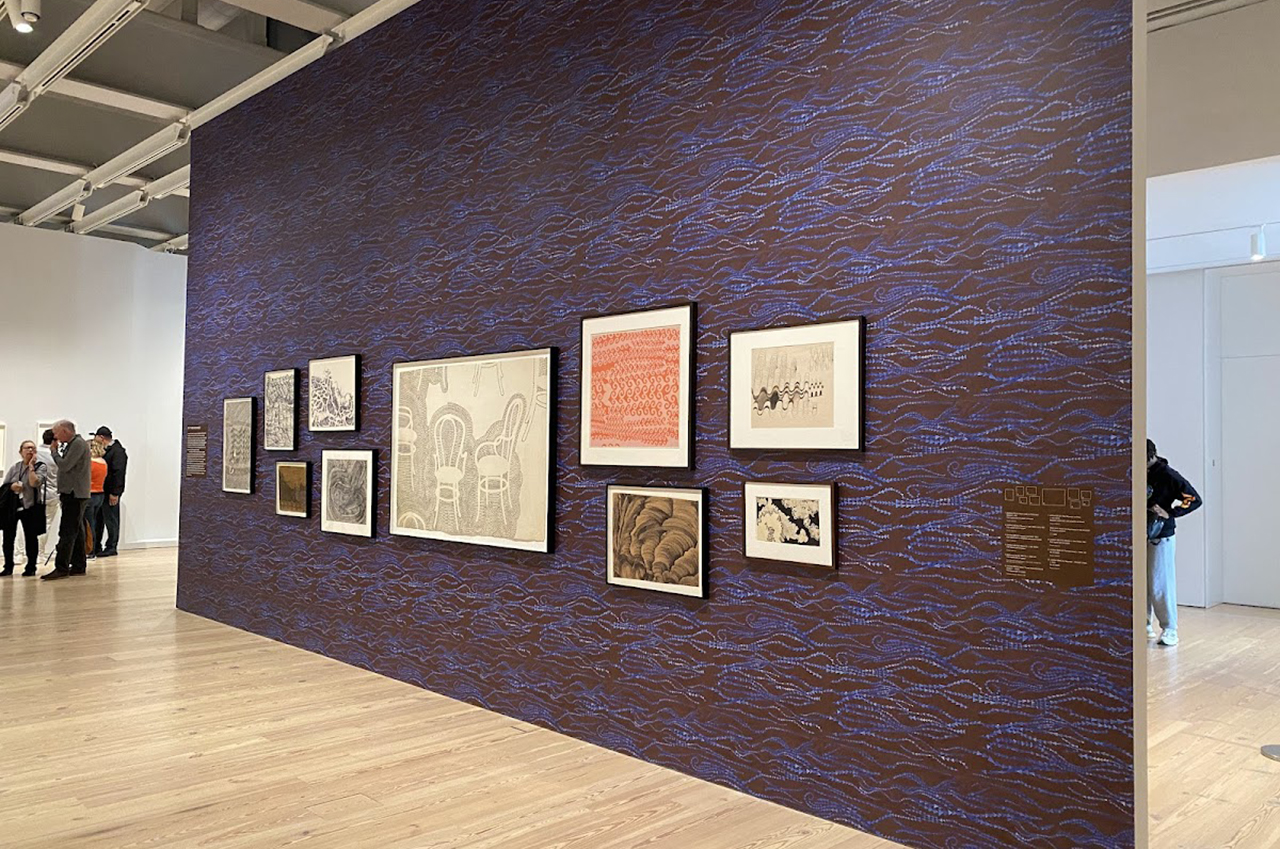
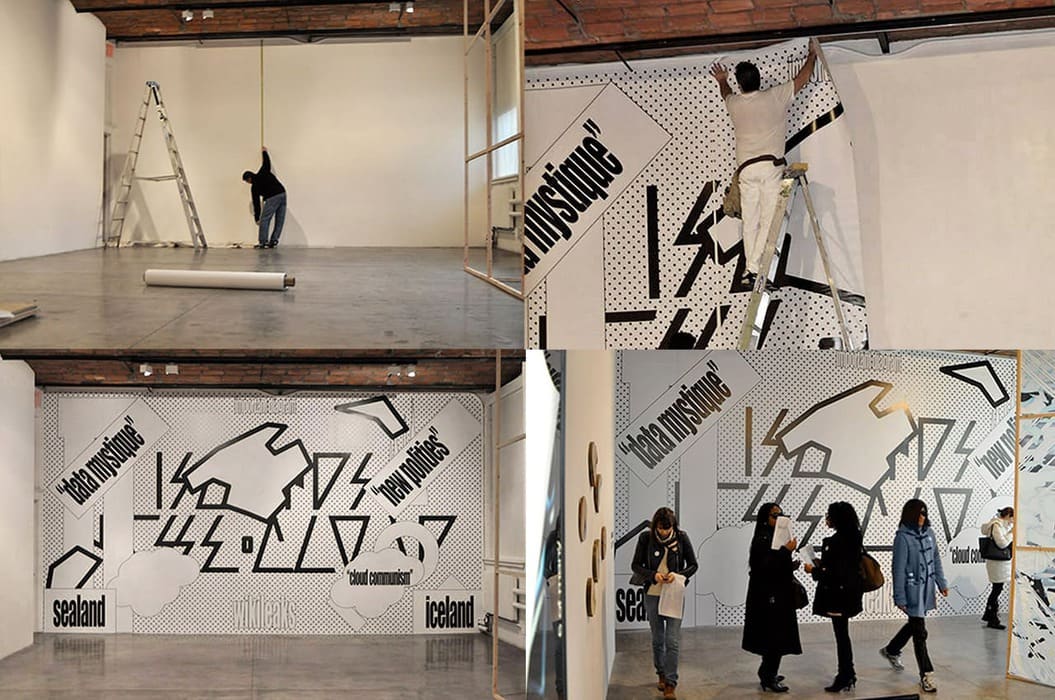
Do you work with museums and galleries? Yes. We’ve printed exhibition wallpaper for Ruth Asawa at the Whitney and Metahaven at MoMA PS1.
Making Wallpaper Part of Your Work?
If you’re an artist who wants to work at the scale of a room, send us your images and your space. See our custom wall murals, or send us your project details.