Project
Ruth Asawa Wallpaper for the Whitney Museum's Through Line Exhibition
How we turned a Ruth Asawa painting into a 28-foot gallery wall of wallpaper for Ruth Asawa Through Line at the Whitney: material samples, color matching, scale proofs and a panel schematic.
 By Joseph A. Gornail
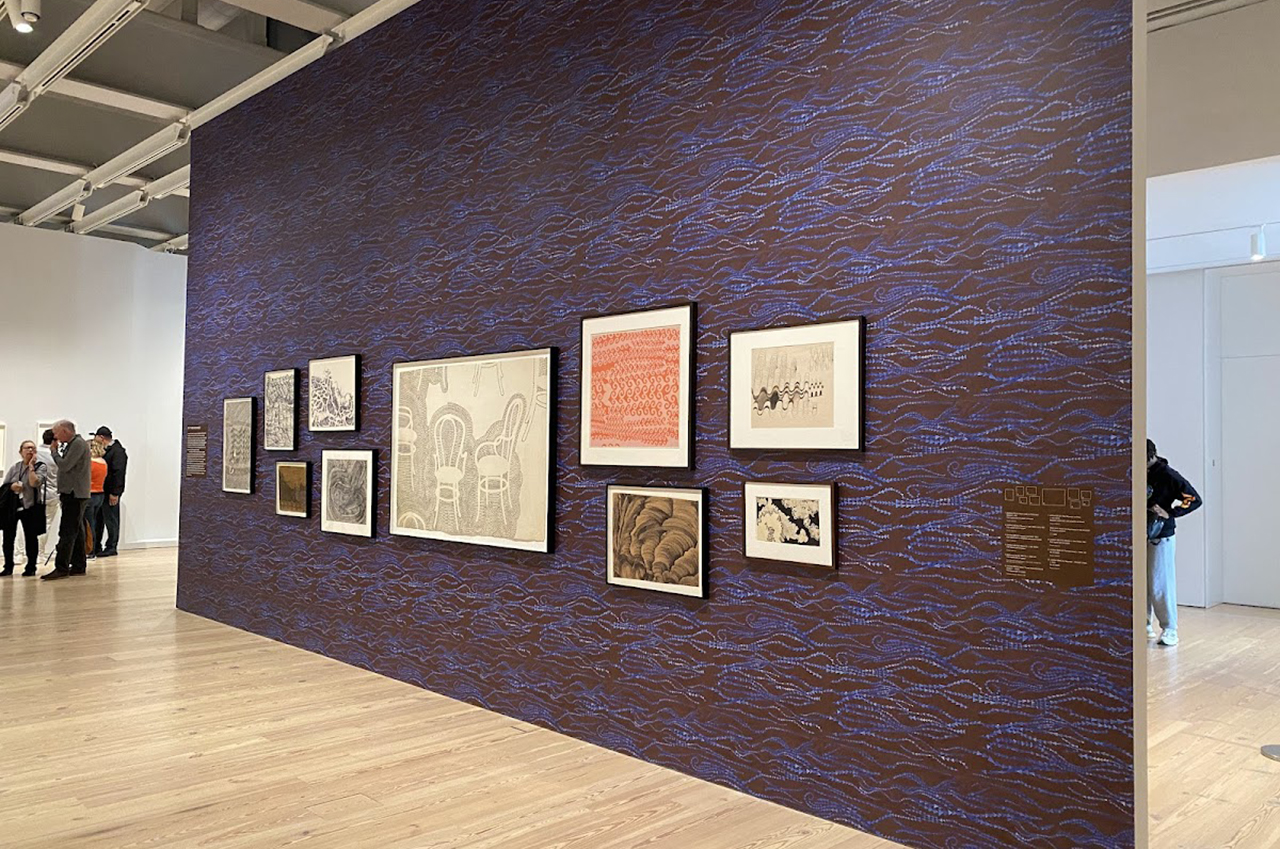
In February 2023, the exhibitions team at the Whitney Museum of American Art called with an unusual brief. For Ruth Asawa Through Line, the museum wanted one of Asawa’s paintings, chains of small blue triangles flowing like water across a deep brown ground, turned into wallpaper for a gallery wall 28′5″ wide and 16 feet tall. They wanted it on “a very matte paper,” ideally a real paper, and they wanted it to “feel residential.”
Six months of samples and proofs, and one gallery meeting, later, the wall was up behind a run of Asawa’s drawings.
The Exhibition
Ruth Asawa Through Line ran at the Whitney from September 16, 2023 to January 15, 2024. Best known for her looped-wire sculptures, Ruth Asawa (1926–2013) drew every day, and the exhibition made drawing the through line of her work, with more than one hundred works, many never shown before. It was co-organized by Kim Conaty of the Whitney and Edouard Kopp of the Menil Drawing Institute, and traveled to the Menil in Houston after it closed in New York.
Our contact throughout was Abigail Hack of the Whitney’s Exhibitions & Collections Management team.
Project Specifications
- Client: Whitney Museum of American Art, for Ruth Asawa Through Line
- Artwork: an image of an Asawa painting, tiled by the Whitney’s designers into a repeat
- Wall: 28′5″ wide × 16′ tall
- Material: Mystical, a traditional unpasted wallpaper with no adhesive backing
- Layout: 7 panels at 16′4″ × 53.6″, with 1″ overlap between panels
- Total: 511 sq ft of wall, plus one extra panel: 584 sq ft printed
- Installation: the museum’s own installer
Choosing the Paper
All of our samples are made to order, so we started with what we had in-house: we printed the artwork on a range of our wallpaper substrates and had them messengered to the museum. The team narrowed it to two, Nolar, the flat matte paper we’d first suggested, and Mystical. By April their answer was clear:
“We really loved the Mystical texture sample you sent.” — Abigail Hack, Whitney Museum of American Art
Mystical gave them the soft, matte, residential feel they were after, with a subtle texture that suits a painted surface. It’s a traditional wallpaper with no peel-and-stick backing, which mattered: when one of the museum’s install vendors asked whether it was self-adhesive, we confirmed it hangs like any traditional wallcovering, and corrected a line on our own website that had said otherwise.
From a Low-Res Image to a Print File
The first image the Whitney sent was low resolution, so our pre-press team enhanced it enough to proof from while the museum sourced a sharper file. In May a new high-resolution TIF arrived, and the team asked for three versions side by side: as-is, slightly warmer and slightly cooler. They needed them by the end of Thursday; the file reached pre-press Monday, and the proofs were at the museum by 9am Thursday.
Along the way we answered the practical questions that decide how a repeat is built:
- Panel width follows the image. Panel dimensions are based directly on the size of the repeat, up to the width of the roll.
- Resolution: whatever the final scale, the artwork should be at least 300 dpi at print size.
- 1.5 repeats per panel is possible, but it means two different panel types (left and right), which makes installation more complicated than it needs to be.
Color Matching a Painting
Comparing the new proofs against the original painting, the team found the colors “close, but not quite balanced.” The high-resolution image was much warmer than the first low-res one, the white areas of the triangles were getting lost, and they wanted more contrast between white and blue and a cooler brown.
The painting’s colors aren’t flat. The blues are washes, and the brown ground is full of brushwork, so we isolated the artwork into its two color families, the blue triangles and the brown ground, and adjusted each one on its own.
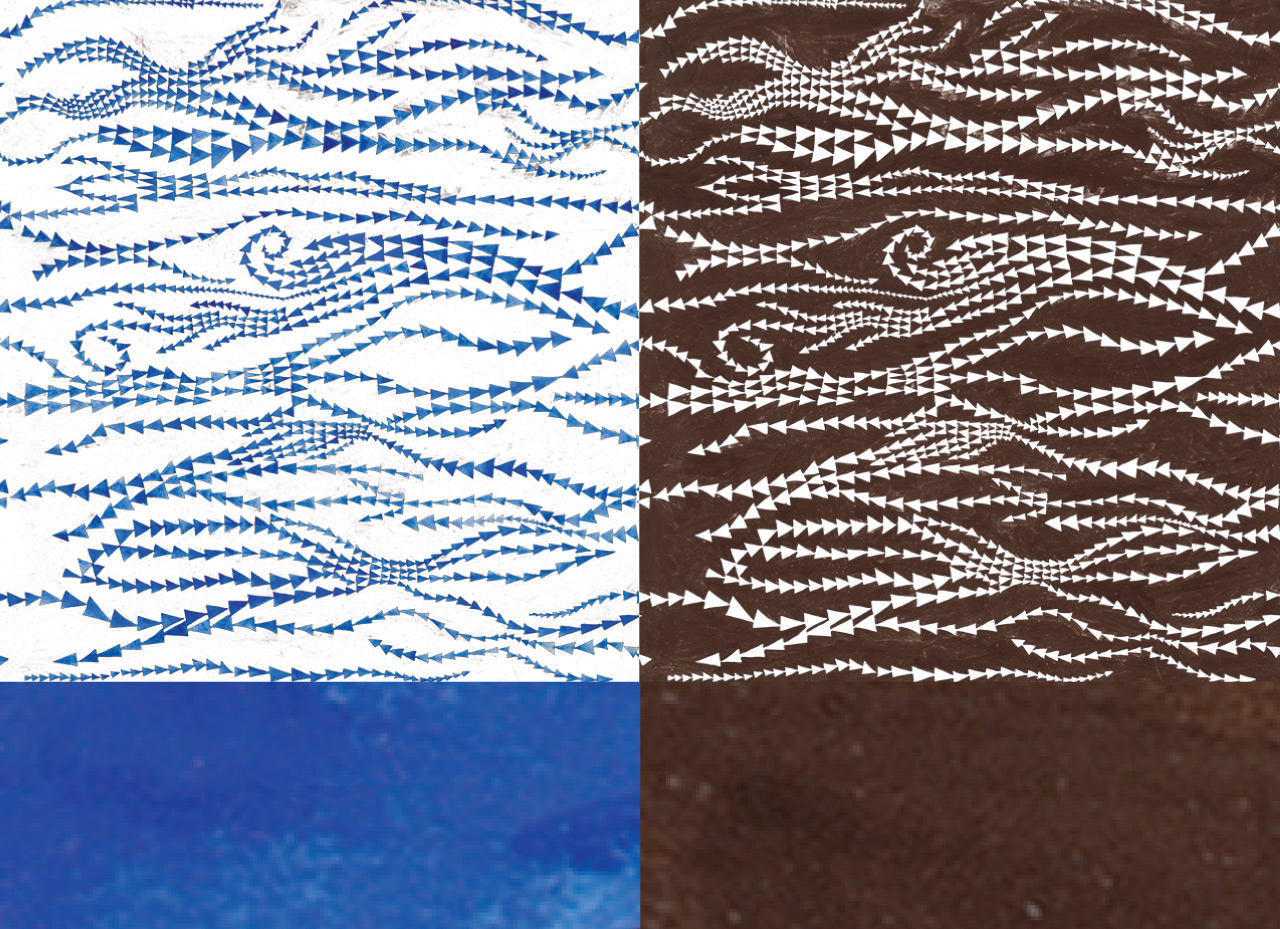
Two color families, isolated: the blue triangles and the brown ground, each with the texture of the paint intact.
The blue came quickly. The brown took longer, which is what we’d expect: neutral colors are the most sensitive to match, and a small shift reads immediately as too warm, too red or too gray. In July we met the Whitney team in their galleries with a printed color chart to talk through the options in person, and the final round of proofs put two versions side by side at the chosen scale, one with the brown areas adjusted, so the team could make the last call on the wall itself. Our color matching process works the same way: printed options, judged in the light where they’ll hang.
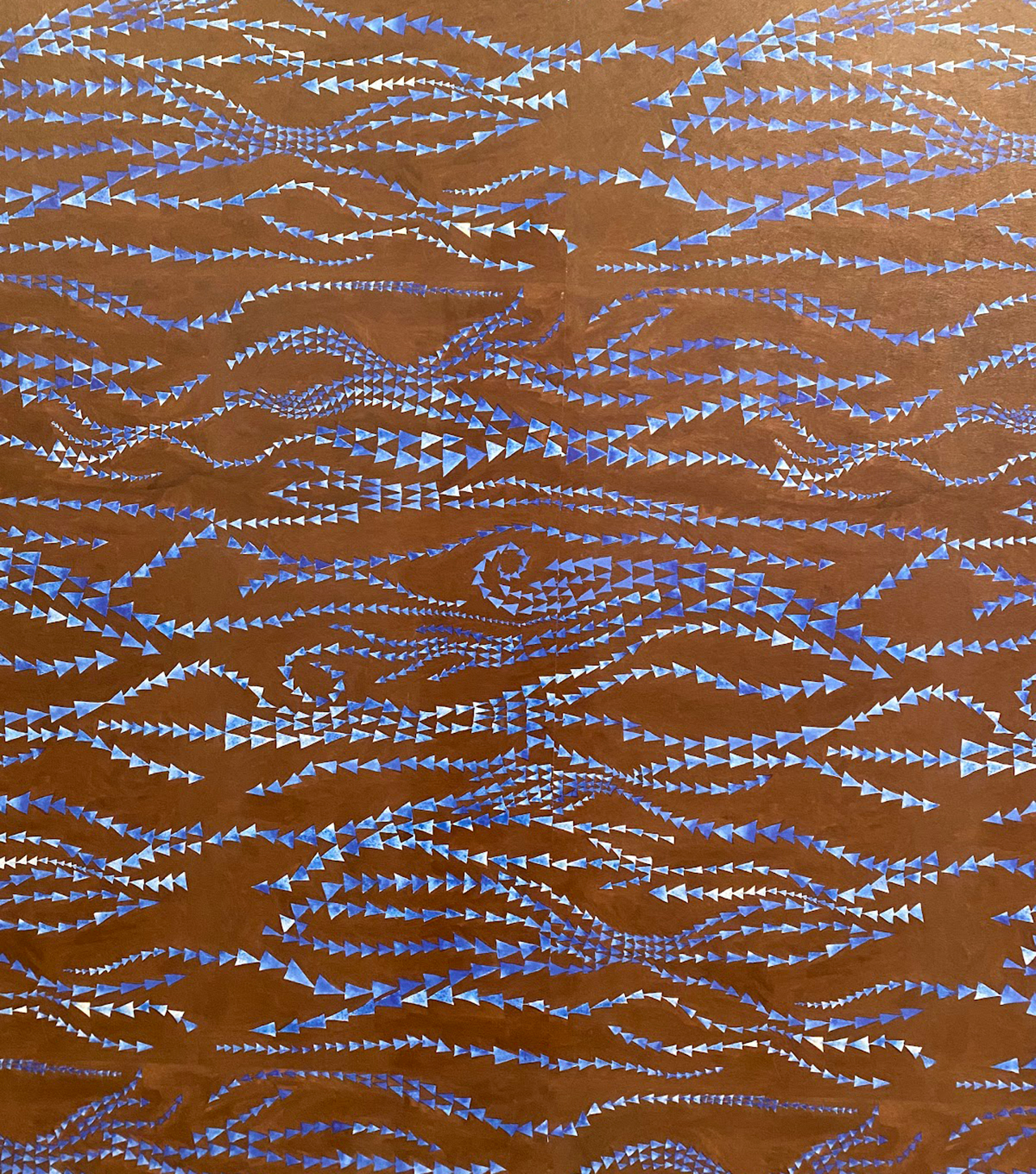
The printed pattern up close, with the painted texture of the original carried through.
Finding the Right Scale
Scale was its own decision. We first sent PDFs of scale options, then, at the team’s request, smaller steps. They asked to see them in print, so we printed six proofs at 26″ × 52″, one each at 100%, 105%, 110%, 115%, 120% and 125%, each labeled, so they could compare them at full size. They chose 110%. The final file had a 26.31″ repeat with 1″ of bleed on either side for tiling.
Every one of these is a press proof on the real material. For a gallery wall this large, it’s the only way to judge color and scale before committing to production.
The Panel Schematic
With the scale set, the museum sent the floor plan, with the wallpaper wall marked in red, and photos of the space. They asked for some vertical bleed, because gallery floors are rarely perfectly level and the installer might need to trim to fit. We drew up a schematic with the full panel breakdown: seven panels at 16′4″ × 53.6″, 1″ of overlap at each seam, 511 square feet of wall. We recommended one extra panel as a backup, for 584 square feet in all. The museum agreed, signed off on a final proof on August 9, and we went to production.
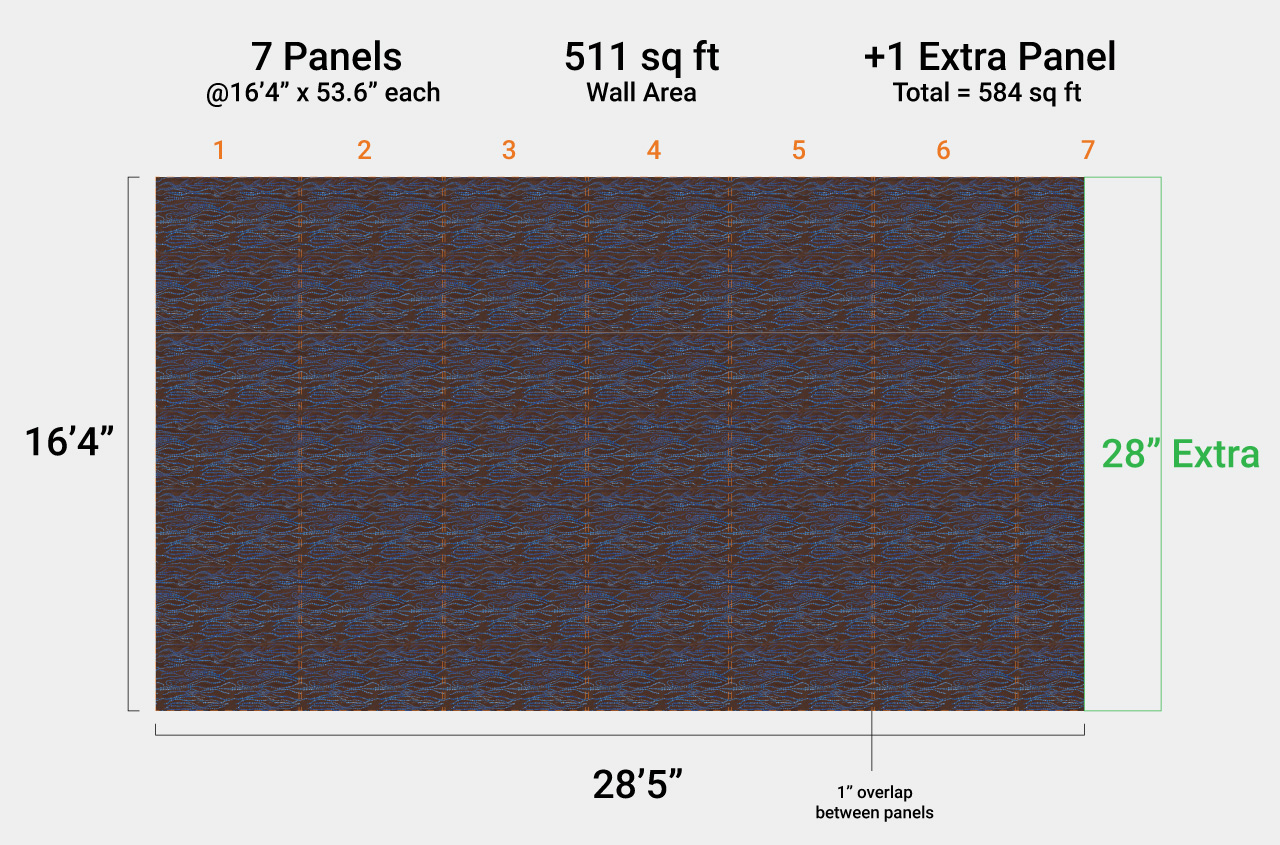
The final panel breakdown: seven panels, 1″ overlaps, and one spare.
Installation, and Why You Order Extra
At the end of August, Abigail wrote from the gallery:
“We are well underway installing the panels. They look beautiful!” — Abigail Hack, Whitney Museum of American Art
One seam, though, wasn’t lining up: the pattern was staggered by almost half an inch at the top and bottom of the wall. Because every panel is printed identically, a printing fault would have shown up at every seam, not just one. Comparing the photos, we could see the panel had been set about half an inch off, both horizontally and vertically. The installer hadn’t accounted for the extra half inch of material we print on each side of every panel.
That’s exactly what the spare panel was for. The museum had followed our advice to order one, so the panel could be rehung and it all worked out in the end. It’s the reason we always recommend ordering around 15% more than the wall measures.
Earlier in the project, Abigail summed up the process:
“Thank you for your patience and diligence throughout this process.” — Abigail Hack, Whitney Museum of American Art
What This Project Taught Us
- Sample on the real materials first. Seeing the artwork on several papers settled the material before any color work began.
- Isolate color families. When a painting’s colors aren’t solid, adjusting each family separately is what makes a match possible.
- Neutrals are the hard part. Blues come fast; browns and grays need extra rounds.
- Proof scale in print, not just on screen. Six full-size prints made a 5% difference easy to judge.
- Plan the seams on paper. A schematic with every panel measured gives the installer a map, and makes trims and bleed explicit.
- Always order a spare. One extra panel turned an installation mistake into a non-event.
Questions We Hear About Museum Wallpaper
Can you turn a painting into wallpaper? Yes. We print from the image you supply, at the scale you choose, after proofing color and scale on the actual material. Supply the highest resolution you can: at least 300 dpi at final print size.
How do you match a painting’s colors? With printed proofs judged against the original. Where colors aren’t flat, as in Asawa’s washes and brushwork, we isolate each color family and adjust it on its own. Neutrals like browns take the most rounds.
How much extra wallpaper should I order? We recommend about 15% over the measured wall area, or at least one spare panel. It covers trimming, installer error and future repairs. See how to measure surfaces for wallpaper.
What do you send the museum’s installer? The printed panels and a schematic of how they hang. We print, and your installer hangs it; at the Whitney, the museum’s own installer did. Our guide to preparing wall surfaces can be passed straight to your installer.
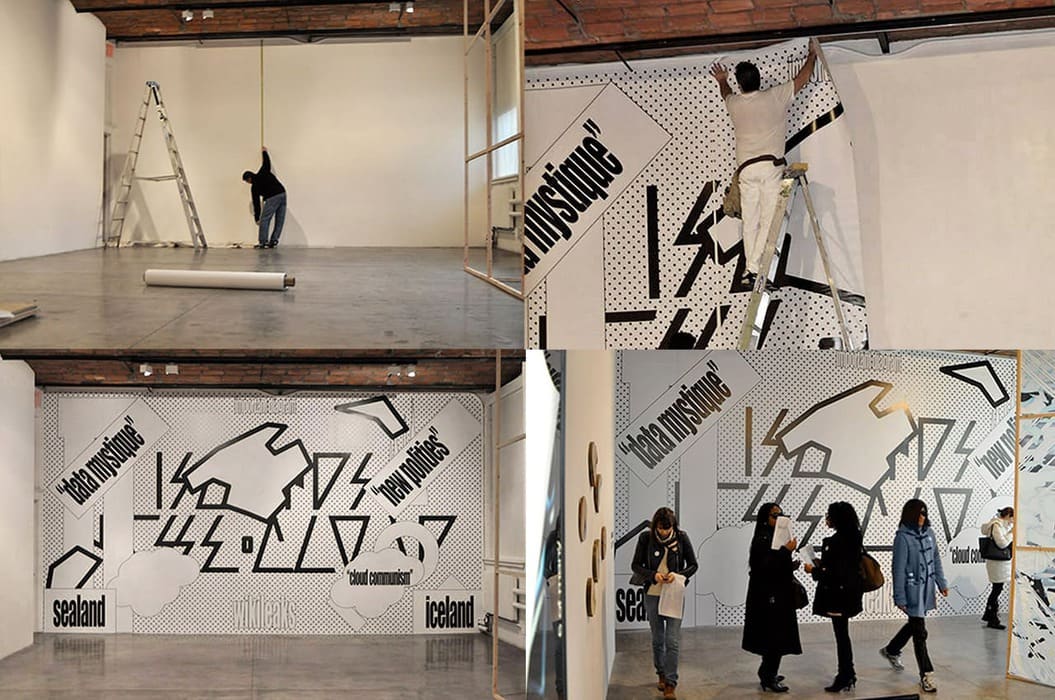
Do you work with other museums? Yes. We printed exhibition wallpaper for Metahaven at MoMA PS1 and for The Drawing Center, and we print for artists and galleries of every size.
Planning an Exhibition Wall?
If you’re turning an artwork into a gallery wall, we’ll sample it on real materials, proof the color and scale until it’s right, and map every panel before production. See our custom wall murals, or send us your project details and your opening date.