Case Study
Bringing Back a Lost Parlor Wallpaper for a 1905 Dutch Colonial in Kansas
How we recreated a damaged floral parlor wallpaper for a 1905 Dutch Colonial in Lincoln, Kansas, featured on Magnolia Network's In With the Old: 1000 dpi scans, hand reconstruction, 8-color separation and proofs that kept the original's aged look.
 By Steven D. Garcia

In April 2024, Julie Flores wrote to us from Lincoln, Kansas. For a year and a half, she and her husband had been renovating and restoring their 1905 Dutch Colonial, a project featured on Magnolia Network’s In With the Old (Season 5, Episode 1). Their goal was to make the house new and functional while saving as much of its history as they could.
One piece of that history hadn’t survived: a floral wallpaper in the parlor, too damaged to save during the first-floor renovation. They had already hired someone who promised to remake it. More than a year later, they still hadn’t seen a single proof.
“We have waited almost 2 years to see this wallpaper come back to life!” — Julie Flores

The sample as it arrived: torn strips of the parlor wallpaper, mailed from Kansas.
What Survived
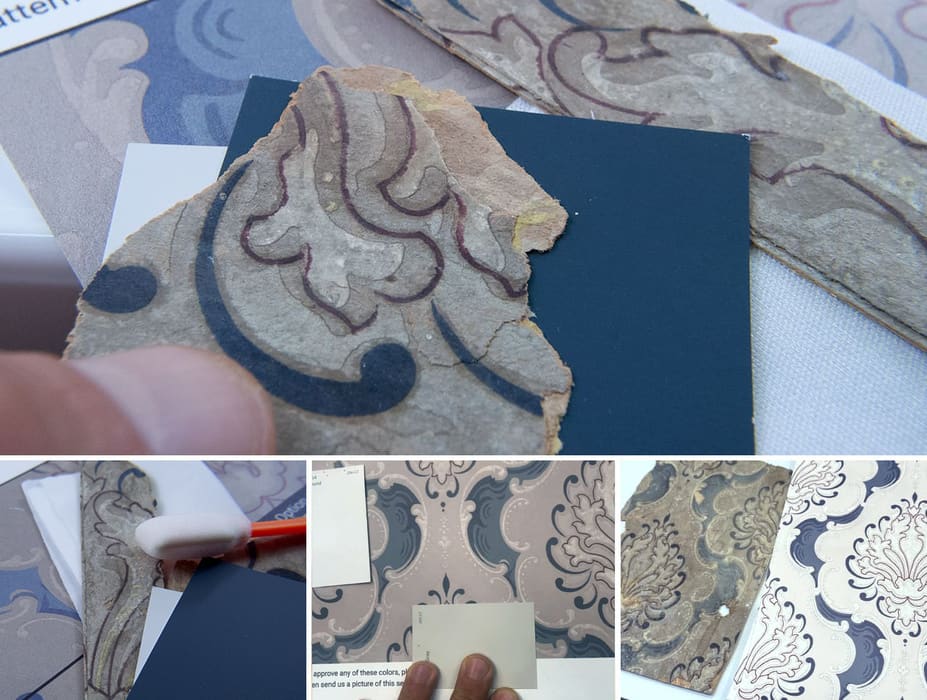
Julie mailed us the pieces she had. The paper had suffered badly from water and mold, and it arrived in strips: torn edges, creases, stains and faded color, with the ribbed texture of the original paper still visible.

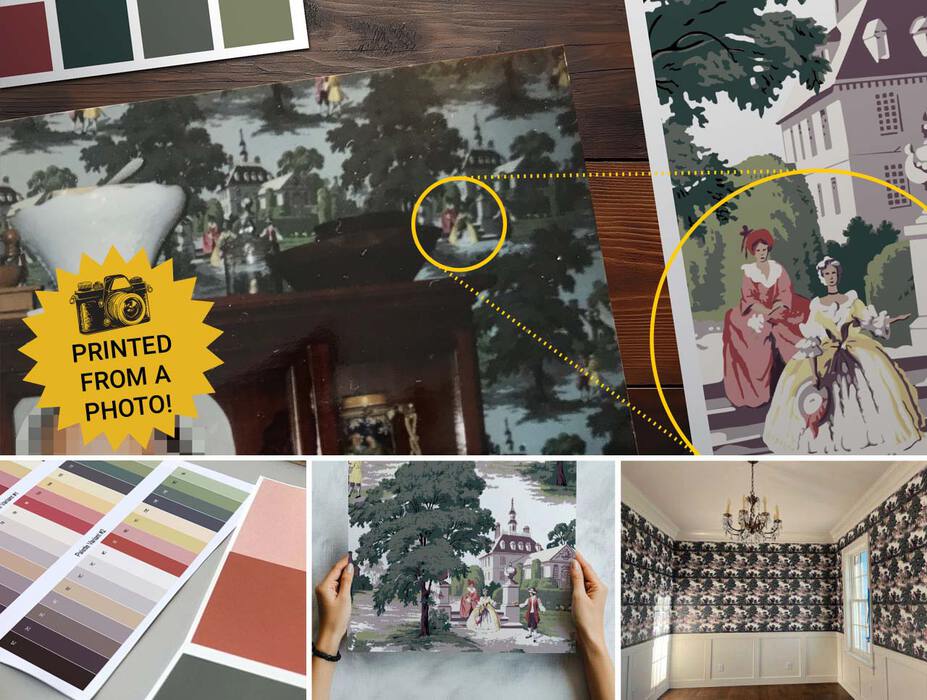
Worse, the fragments didn’t contain the whole design. A large part of the repeat existed only in a blurry, low-resolution photo of the wall, far too pixelated to print from but just clear enough to rebuild from.

Prognosis: heavy damage, an intricate design and faded colors.
Our pre-press team’s first read was honest: the design was full of blends and colors that would be hard to isolate. Julie chose our Precision Archival service, with up to five rounds of press proofs, to give the color match the best possible chance.

The only record of the full repeat: a low-resolution photo.
Project Specifications
- Client: Julie Flores, for the parlor of her 1905 Dutch Colonial in Lincoln, Kansas
- Source: damaged wallpaper fragments, mailed in, plus a low-resolution photo of the full pattern
- Service: Precision Archival recreation, up to 5 rounds of press proofs
- Colors: 8, each separated on its own layer
- Material: DreamScape Nolar Smooth, a traditional paper with no adhesive backing
- Printing: Mimaki UCJV300-160, UV-cured CMYK inks
- Total: 150 sq ft
Cleaning Up the Damage
We scanned the fragments at 1000 dpi, which captured every fiber, and every flaw: scratches, stains, rips and blemishes. We cleaned those up by hand in Photoshop. We don’t mind a little grit in an antique wallpaper (as it turned out, neither did Julie), but tears and water stains aren’t part of the design.

Our 1000 dpi scans revealed every scratch, stain and rip; each was repaired by hand.
Rebuilding the Missing Pattern
With the fragments cleaned, we laid them over the low-resolution photo to map where each piece belonged in the full repeat, and to see exactly what was missing.

Fragments placed over the photo: the starting map for the reconstruction.
From there, the work was by hand. The scan gets close and shows where we need to go, but an artist has to fill every gap to complete the pattern for high-resolution printing, matching the linework, the texture of the ink and the character of the original.

The flowers took longer than we first estimated. Each bloom is built from thousands of tiny shapes, and the design’s blends had to be organized carefully so every color stayed in the right group.

Thousands of hand-built shapes: the most labor-intensive part of any recreation.
Eight Colors, Separated
With the full design rebuilt as a seamless repeat, we traced and isolated each of its eight colors onto its own layer. That separation is what gives our prepress team precise control over every color in the proofing rounds.

Too Clean, Then Just Right
Our first press proof gave Julie a “scrubbed” version of the pattern: cleaner and more vibrant than the faded original.

It was too bright. The printing quality was right, but the Floreses didn’t want a brand-new wallpaper; they wanted their wallpaper, with the grit and aging that made it belong to the house.

The first proof: technically clean, but too bright for a 1905 parlor.
So we went back to the original as the standard. With each color on its own layer, we could pull the palette back toward the fragment, warming and dulling it until the proof read as aged rather than new, checked against color book swatches along the way.

Each round brought the proof closer. Layered side by side, the progression shows the colors moving from fresh print toward the weathered original.

By the final round, the original fragment and the proof sat side by side with the same character: the same blues, the same ochre, the same lived-in softness.

Original over proof: matched to the aged color, not the new one.
When the proofs arrived in Kansas, Julie wrote back:
“We received the wallpaper sample proofs and love them!” — Julie Flores
She marked her favorite option and sent us a photo of the signed-off proof, so both sides were working from the same approved sheet.

Printing the Rolls
With the color approved, we printed 150 square feet on DreamScape Nolar Smooth, a traditional paper with no adhesive backing, in keeping with a historic parlor. We watched the run throughout to keep the color consistent from the first panel to the last against the approved proof.

On press: the approved pattern, cured by UV light as it prints.
What This Project Taught Us
- Fragments plus a photo is enough. Torn pieces carry the detail; even a blurry photo can map the rest of the repeat.
- Don’t over-restore. The cleanest version isn’t always the right one. For a historic house, the aging is part of the design.
- Separate the colors early. Eight independent layers made it possible to pull the palette back toward the original without redrawing anything.
- Flowers take time. Intricate blends and hand-drawn blooms are where recreation hours go; honest estimates leave room for them.
- Proofs, not promises. After a year without a single proof elsewhere, printed proofs on the real paper were what the Floreses needed to trust the process.
Questions We Hear About Recreating Damaged Wallpaper
Can you recreate wallpaper that’s water- or mold-damaged? Yes. We scan the surviving pieces at high resolution, repair the damage digitally and rebuild what’s missing by hand. See our damaged wallpaper restoration service.
What if part of the pattern is missing from my sample? A photo of the wall, even a low-quality one, can be enough to rebuild the rest of the repeat. Our incomplete pattern service covers how.
Can you keep the aged, faded look instead of making it look new? Yes. We can match the color of the original as it is today, grit and all, or clean it up. Most historic homeowners want the first, but not all: for a 90-year-old family damask, the client chose a lighter, cleaner palette. Proofs on the real paper let you decide.
How should I send my wallpaper sample? Flat, protected and with any loose pieces bagged. Our guide to sending wallpaper samples for restoration walks through it.
How many proof rounds will I need? It depends on the design. Intricate, blended patterns like this one benefit from our Precision Archival service, which includes up to five rounds of press proofs.
Bring Your Home’s Wallpaper Back
If your renovation uncovered a wallpaper worth saving, even in pieces, we can rebuild it for your walls. Learn how we restore historic wallpaper, read about reproducing existing wallpaper designs, or send us your samples and photos.