Project
Custom Wallpaper Printing for the Frye Art Museum: Eleven Artist Designs for Wallflowers
Custom wallpaper printing for Wallflowers at the Frye Art Museum, Seattle: eleven artist designs across two galleries, roll-by-roll layout planning, batched production through the holidays, prepress file checks, and a shipping schedule built around a fixed installation window.
 By Steven D. Garcia
A gallery wallpaper commission is usually a single wall. One artist, one design, one installation date.
Wallflowers was eleven artists at once, across two galleries, printed through the holidays and shipped three thousand miles to land inside an installation window that could not move.
The exhibition opened at the Frye Art Museum in Seattle on 7 February 2026. The brief that reached us ten months earlier ran four sentences: ten custom wallpaper designs, two gallery spaces, 4,264 square feet, and a preference for the most matte surface we carried.
Underneath it was a scheduling problem. The artwork could not all exist at once, because eleven artists were still making it. The press could not run it all at once either. Everything that follows came out of those two facts.
The Exhibition
Wallflowers ran at the Frye from 7 February to 17 May 2026, organized by Executive Director and curator Jamilee Lacy with contributing artist Elizabeth Corkery. The show hung historic flower paintings from the Frye’s own collection against walls papered by eleven living artists — Gamble and Fechin and Griffin, surrounded by wallpaper made in 2025.
The eleven commissioned artists were Jite Agbro, Polly Apfelbaum, Nick Cave and Bob Faust, Elizabeth Corkery, Azadeh Gholizadeh, Patricia Iglesias Peco, Greg Ito, Koak, Graham McDougal and Natani Notah. Their wall labels read inkjet print on vinyl wallpaper. That line is us.
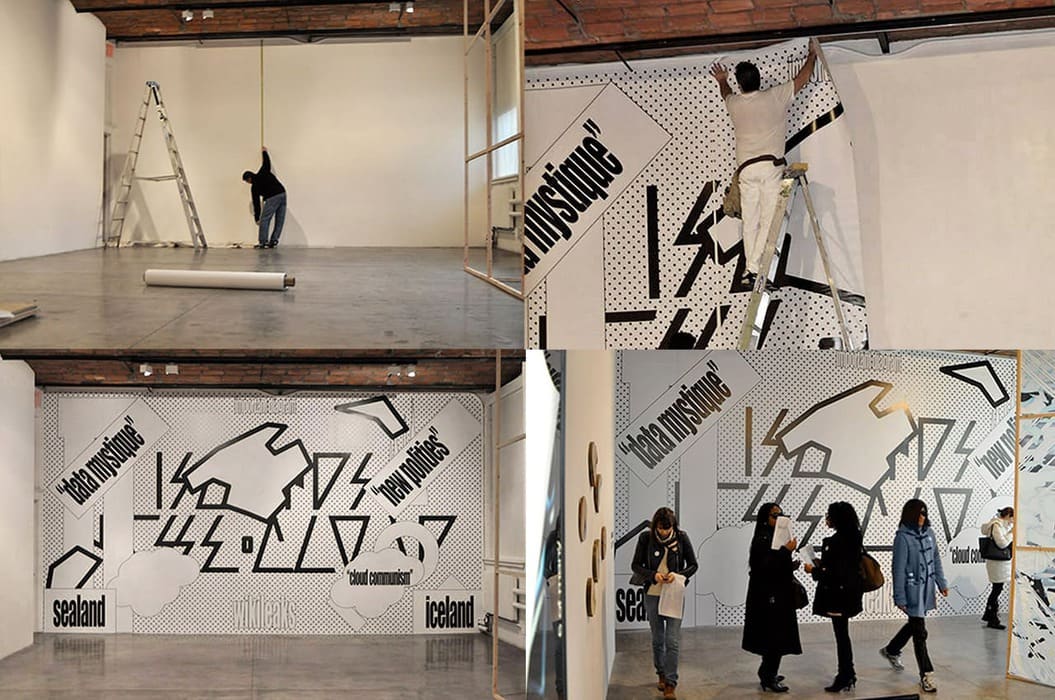
Every design was its own wallpaper: its own repeat, its own color, its own panel count. Some used the full thirteen-foot ceiling height as a single repeat. Nick Cave and Bob Faust’s Wallwork ran as a continuous mural around two corners of a four-wall room.
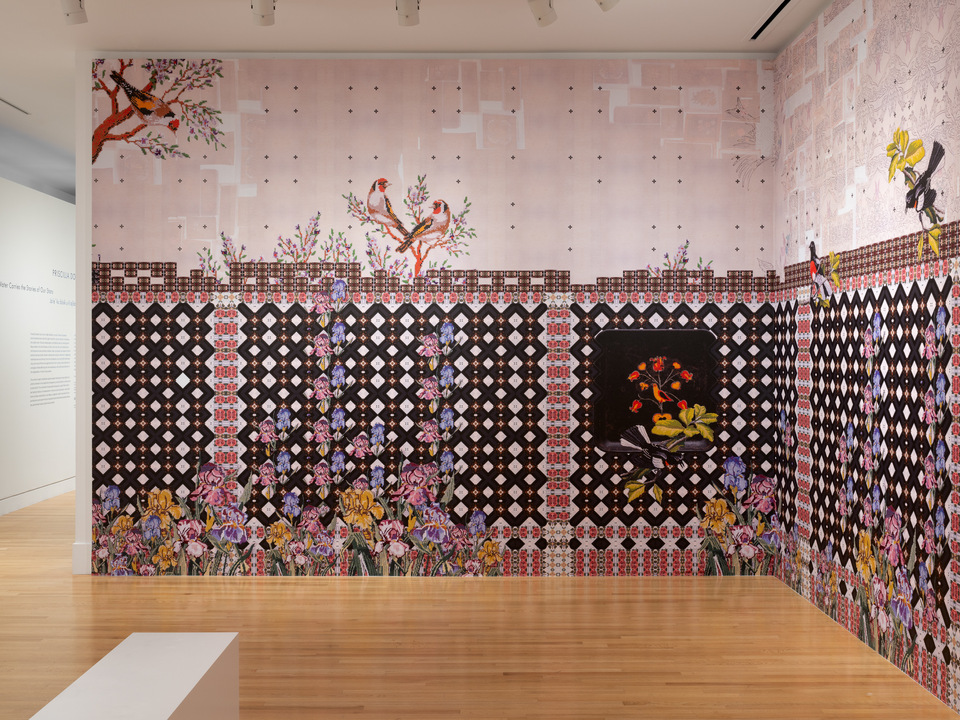
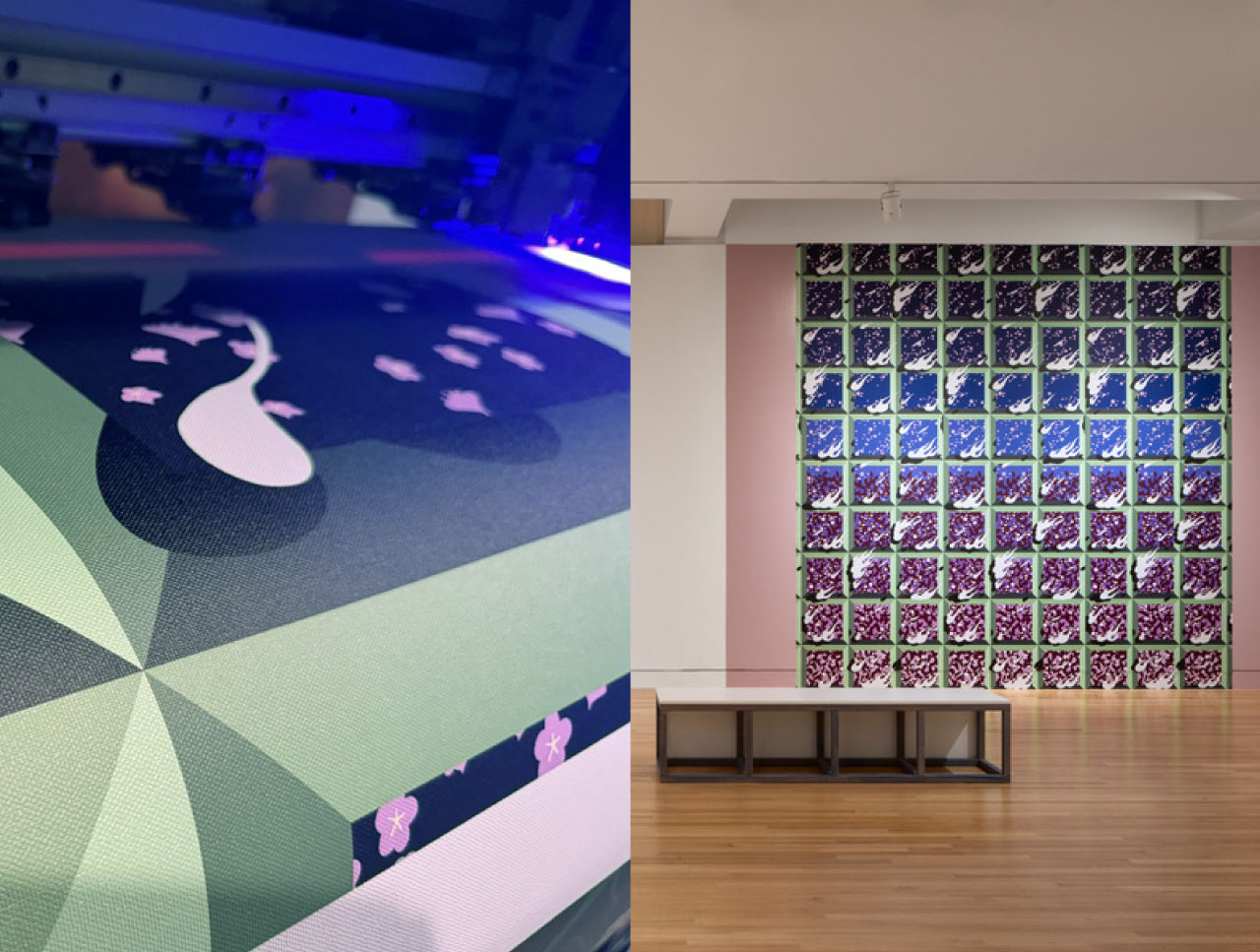
Installation view of Wallflowers, Frye Art Museum, Seattle, 7 February – 17 May 2026. Photo: Jueqian Fang.
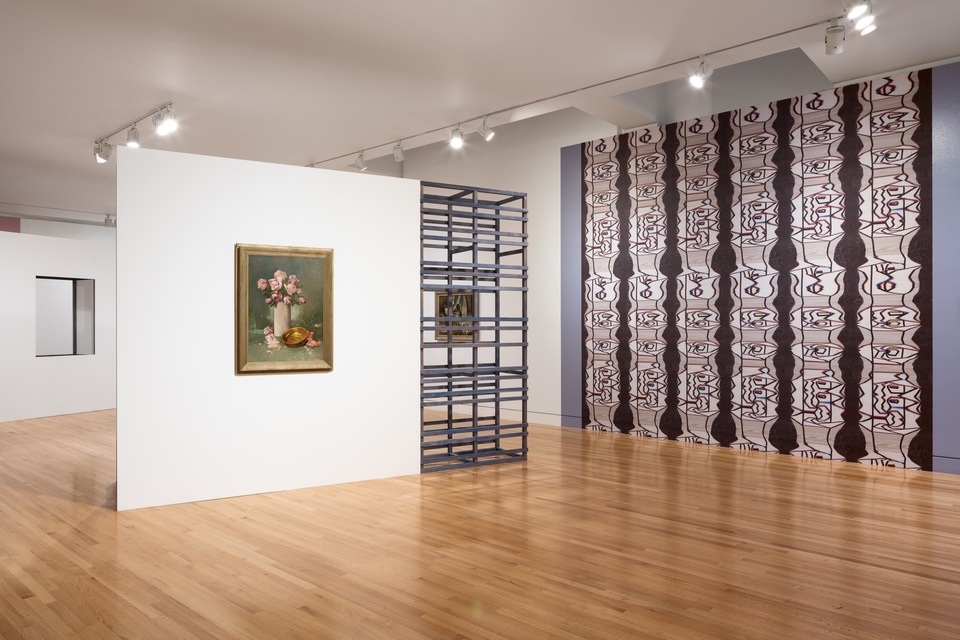
Installation view of Wallflowers, Frye Art Museum, Seattle, 7 February – 17 May 2026. Photo: Jueqian Fang.
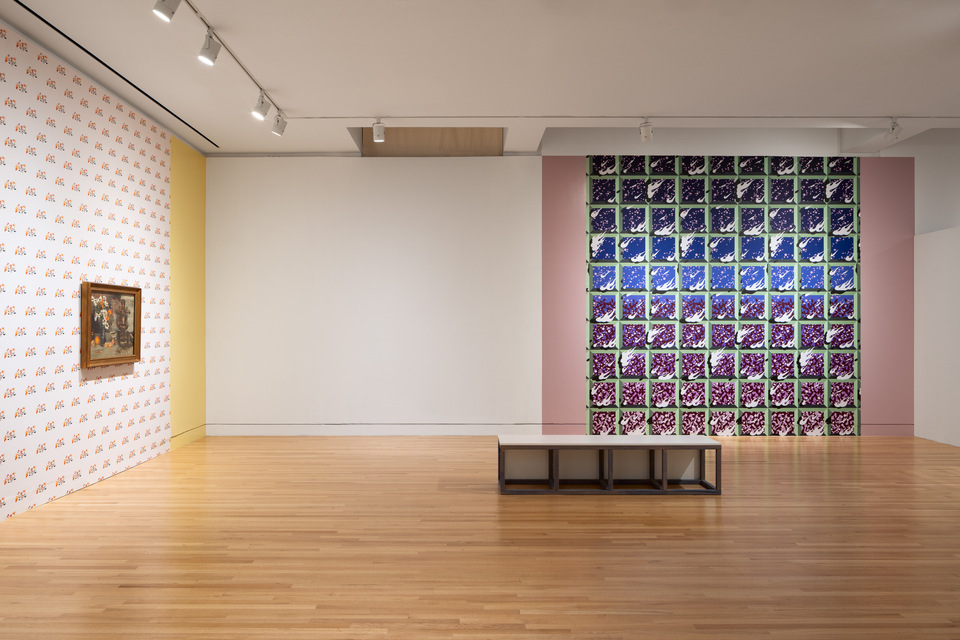
Installation view of Wallflowers, Frye Art Museum, Seattle, 7 February – 17 May 2026. Photo: Jueqian Fang.
Project Specifications
- Client: Frye Art Museum, Seattle, with an external print studio as design partner
- Exhibition: Wallflowers, Frye Art Museum, 7 February – 17 May 2026; organized by Jamilee Lacy with Elizabeth Corkery
- Scope: eleven commissioned artist designs, originally quoted at 4,264 sq ft across two galleries
- Material: DreamScape Ravello — 13 mil textured self-adhesive vinyl, repositionable adhesive
- Panels: 52″ maximum printable width on a 54″ roll; most designs printed at 52″ × 156″
- Overlap: 1″ designed into each panel for a double-cut seam, trimming to 51″ finished
- Quantities: four copies of most designs, five and six of two others, and two murals printed as unique panels — fourteen for one, four for the other
- Coordination: three time zones — design in Sydney, the museum in Seattle, the press in New York
- Production: batched from November 2025 to late January 2026
- Delivery: five shipments, timed to two installation dates
A Quote Before the Artwork Existed
The first inquiry arrived through our website in April 2025, ten months before the opening, and it came with a problem every exhibition has: the budget has to be set before the art exists.
So we quoted the shape of the job rather than the job. Standard rate, bulk rates at 1,000 and 2,500 square feet, and four totals — the bare square footage, then the same number with 15%, 30% and 45% overage built in. Overage is not padding on a project like this. It is the difference between trimming a panel confidently and trimming it while praying.
We also sent a physical sample pack of six materials, because no one specifies a surface for a museum from a screen.
The museum chose Ravello, and we ordered the material months before the first file arrived, so that the substrate was never the thing holding up the press.
Eleven Designs Will Not Print as One Job
By September the artists were still working, and the original plan — all files in by 1 November, everything printed in one run, delivered by mid-December — had become a single point of failure with a date on it.
We had just come off an 8,000 square foot wallpaper project that held the press for over four weeks once you counted changing rolls, swapping inks and recalibrating between designs. Eleven separate designs is eleven of those changeovers. That is not one long print, whatever the square footage says.
So we proposed batching: send artwork as it is finished, proof it, approve it, print it, move on. The alternative was a queue in which every design waited on the slowest artist.
The museum agreed, and the project ran in three batches from November into late January.
Geography set the rhythm as much as the press did. The design liaison worked from Sydney, the museum from Seattle, and the press from New York — seventeen hours between the person preparing the files and the person printing them. A file checked first thing in New York was read that evening in Sydney and came back overnight.
On a single-deadline job that lag is friction. On a batched one it is just the cycle: upload, check, flag, revise, print, move to the next.
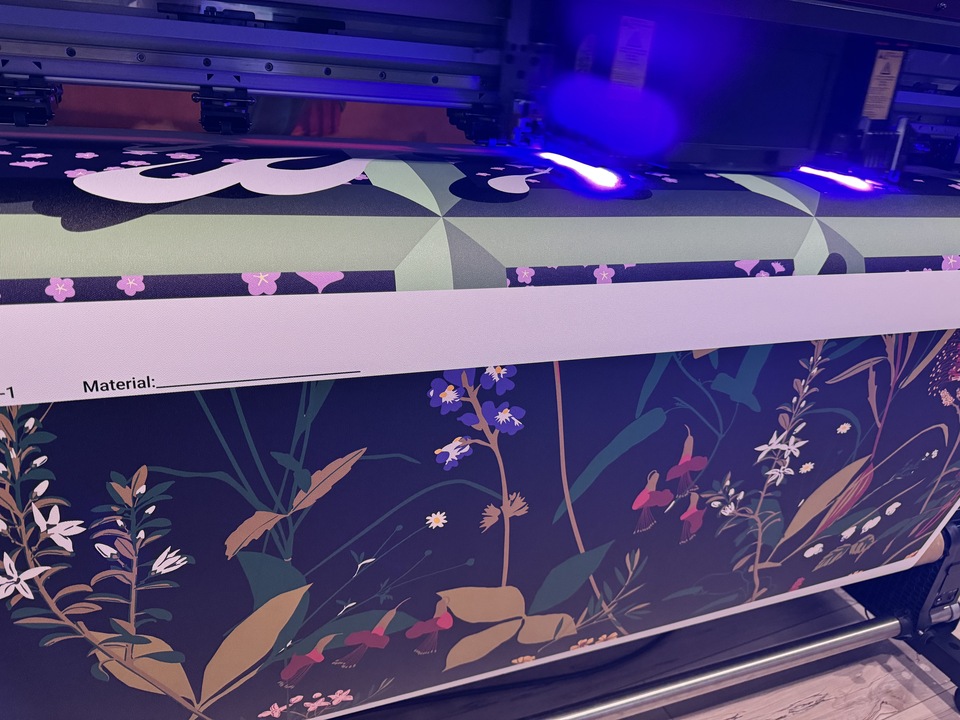
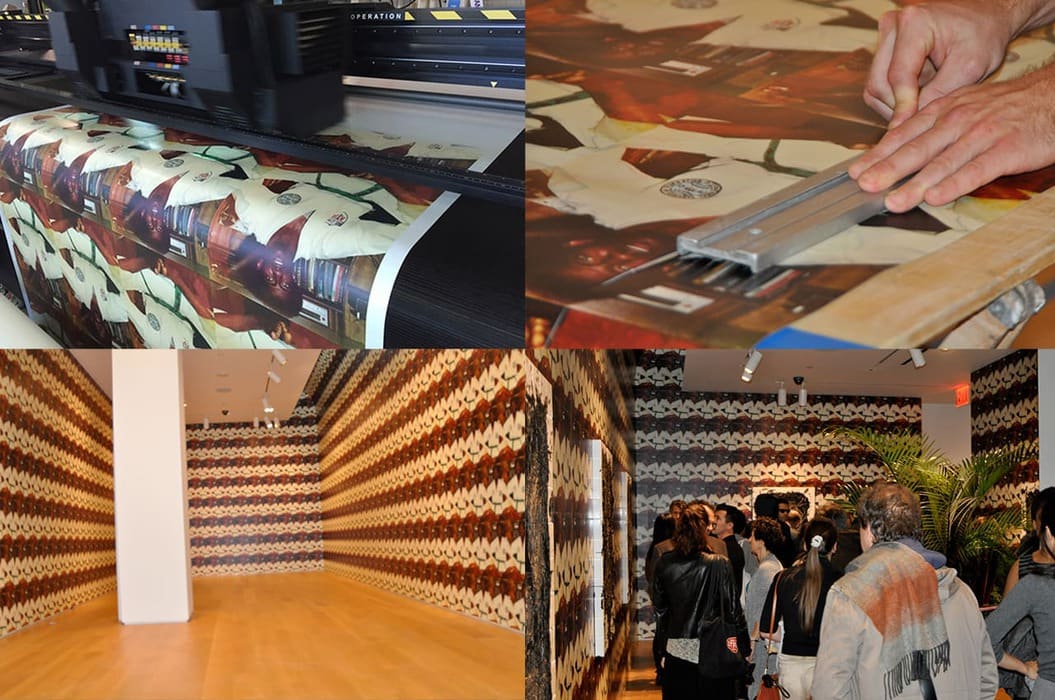
One of the eleven on press. Each design meant its own setup: new roll, ink check, calibration.
Planning the Rolls
Batching solves the schedule. It does not solve the material, and this is the part of a high-volume job that nobody sees.
A 54-inch roll yields 52 inches of printable width. Design a panel at 52 inches and hang it against its neighbor and you have a visible seam. Design it at 52 inches with a 1-inch overlap built in and the installer double-cuts through both layers, peels the waste, and the two panels close to 51 inches with no join to find.
That inch has to exist in the artwork. It cannot be added at the press.
Multiply it out: eleven designs, most at four copies, two at five and six, plus two murals printed as unique panels — fourteen for one and four for the other. Every one of those panels has to be plotted against the others before the press starts, so the material runs efficiently and the press stops as few times as possible.
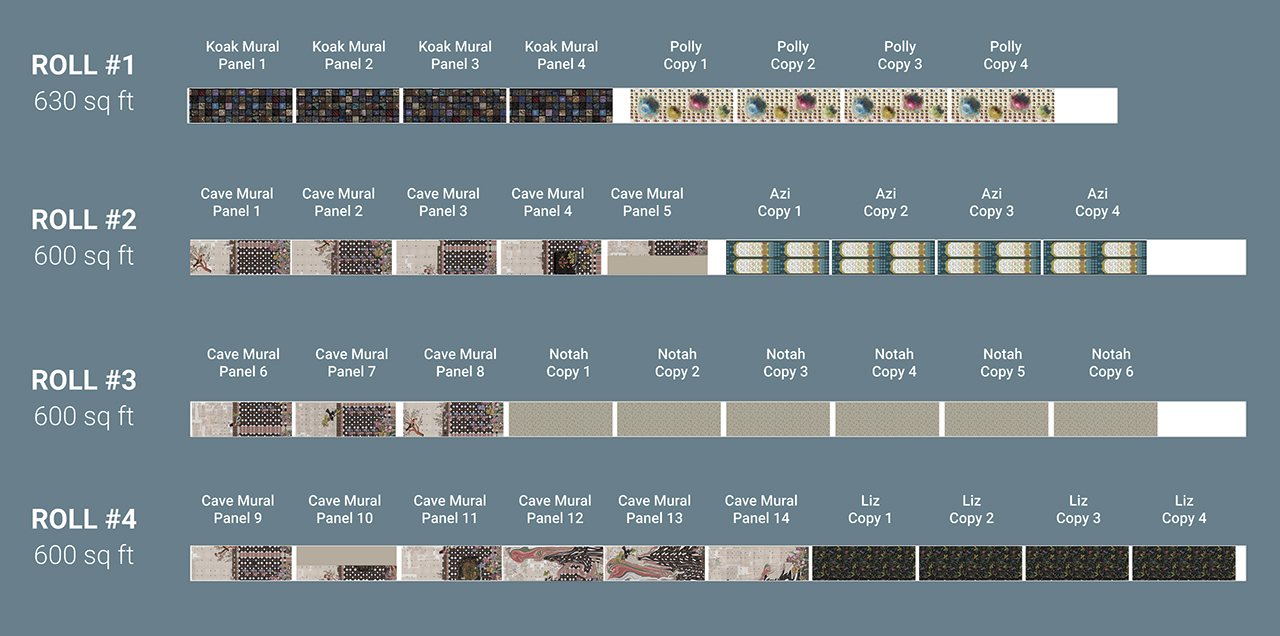
The roll plan: four rolls, 630 square feet on the first and 600 on each of the rest, with every panel placed in the order it would print. The two murals are broken into their numbered panels — fourteen for one, four for the other — and the pattern designs are nested in beside them so the press stops as little as possible.
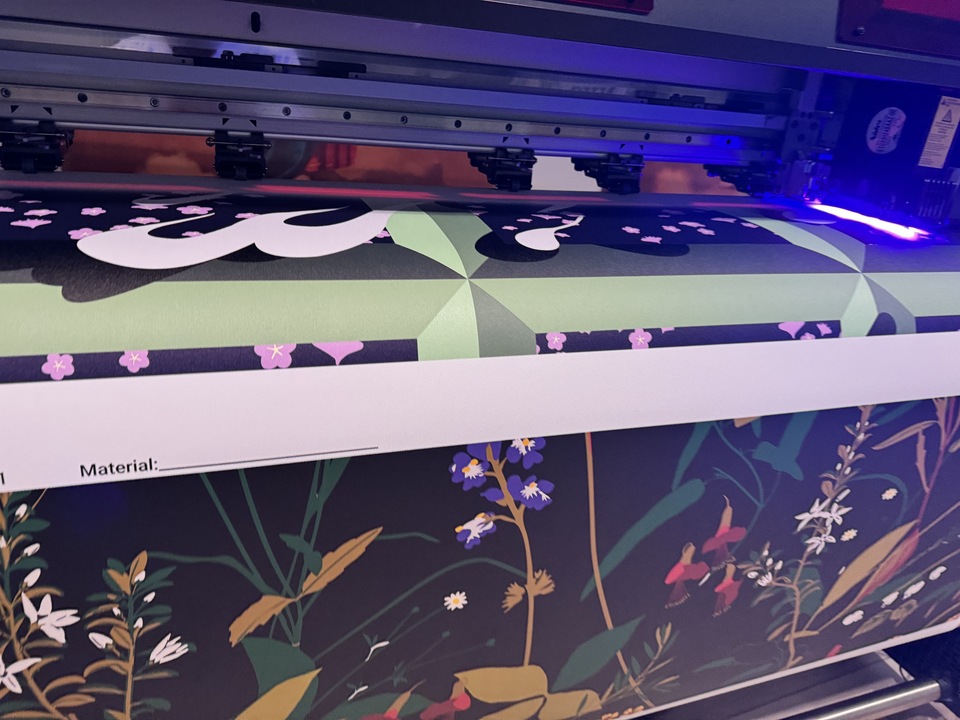
Full width off the press: 52 inches printed on a 54-inch roll.
What Prepress Caught
Eleven artists means eleven different workflows, and files arrive the way files arrive. Our prepress department checked every one before it went near the press, and it is worth saying what that actually means, because it is the step clients are most often charged for and least often shown.
Across the project we found and returned: two files that uploaded at zero bytes and could not be opened at all, one design that arrived at a resolution that would have printed soft at thirteen feet, several files with no bleed where an overlap had been assumed, and one panel built at 53 inches, an inch wider than anything our press can print.
None of that is unusual, and none of it was anyone’s failure. Artists work to their own specs; files get corrupted on upload; a design rescaled after the artist formatted it will fight its own repeat forever afterward. The point is that every one of those would have become a reprint, a delay, or a visible seam if it had been found on press instead of on a screen.
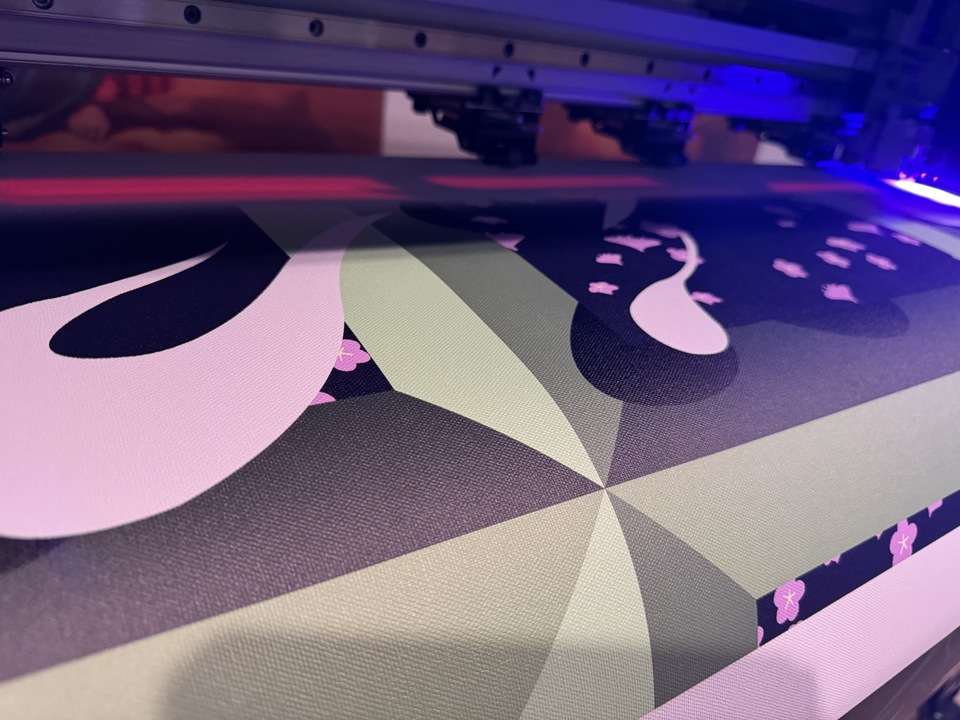
Checked on screen, then checked again on the material. Resolution that survives a 13-foot panel is not the same as resolution that looks fine on a monitor.
The Wall Underneath It
Two months before installation the museum asked a question most printers never get asked, and it was the right one: the installers wanted semi-gloss walls rather than flat, and was that correct?
It was. Ravello is a pressure-sensitive adhesive vinyl. It grips a sealed, smooth surface — eggshell, satin or semi-gloss — and it struggles on flat paint, which is porous enough to weaken the bond over time. Fresh paint should cure for 14 days and ideally 21 before anything is hung on it.
Then came the follow-up, which is the question of someone actually running a build:
“Yikes, we don’t have 14–21 days of cure time in our installation time period. What’s worse, flat paint that’s cured for over 21 days or semi-gloss paint that’s cured for only 4 days?” — Exhibition designer, Frye Art Museum
Semi-gloss at four days. A porous surface is a weak bond even fully cured; a sealed one at four days still gives the adhesive something to hold. With the walls dry to the touch, no paint odor, the HVAC running to keep the air stable, and a wipe-down with a microfiber cloth immediately before hanging, it works — and we offered a test piece from the sample material already on site, so nobody had to take our word for it.
That exchange happened in December. It is the reason there was no adhesion problem in February.
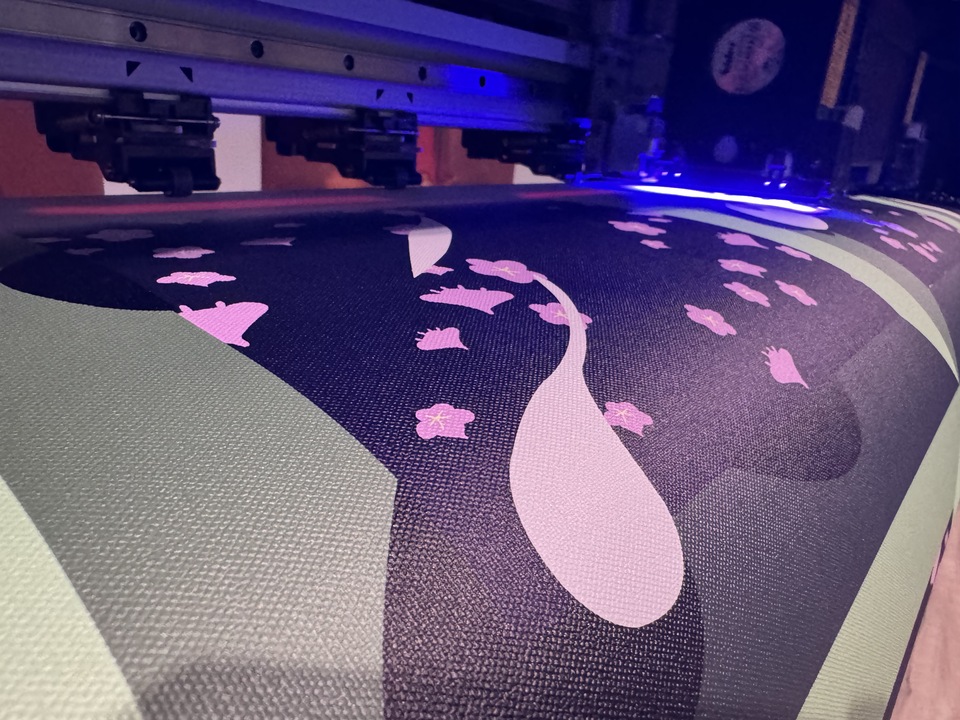
Ravello up close: a 13 mil textured vinyl that will not stretch during installation.
Shipping to a Date That Could Not Move
Installation was booked for Thursday 29 January, with a hard stop on Monday 2 February. After that the galleries belonged to someone else.
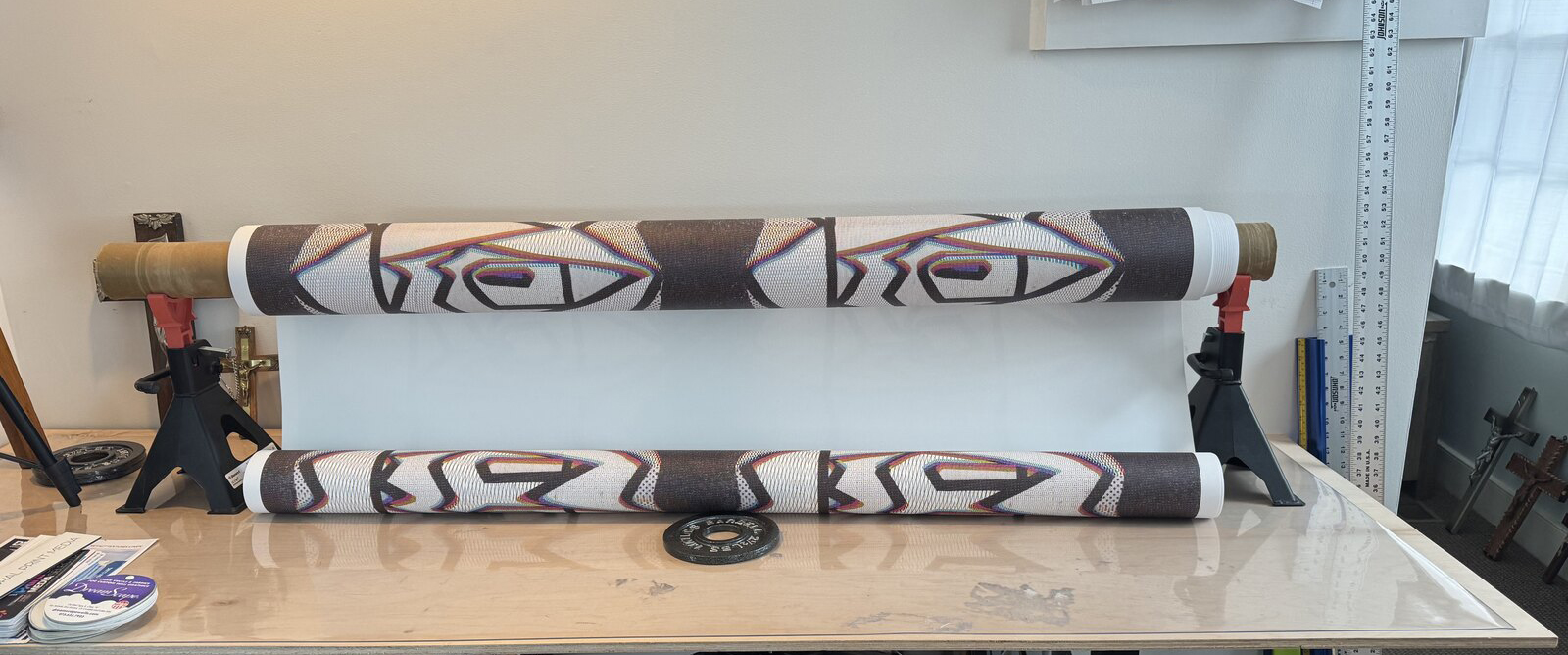
Off the press and onto cores. Every panel is rolled by hand, printed face out, before anything goes in a box.
Materials were ordered the day the second payment cleared. The first shipments went out five days later, and the rest followed across that week — five shipments in all, sequenced so that what the installers needed first arrived first:
| Shipment | Contents |
|---|---|
| 1–3 | Five designs, in install order |
| 4 | First half of the fourteen-panel mural, plus one design |
| 5 | Remaining mural panels, the final two designs, and the second mural |
Everything moved on two-day service, which put the last box on the dock the same morning the installers needed it. The museum saw exactly what we saw:
“It just feels like there’s not much room for error.” — Exhibition designer, Frye Art Museum
There wasn’t. So we priced overnight delivery as a standing option rather than waiting to need it, and when a snowstorm held one shipment at the FedEx hub in Memphis we had our rep put a tracer on it the same day and kept the museum updated rather than letting them discover it from the tracking page.
The last package was overnighted. Everything was on the wall for the opening.
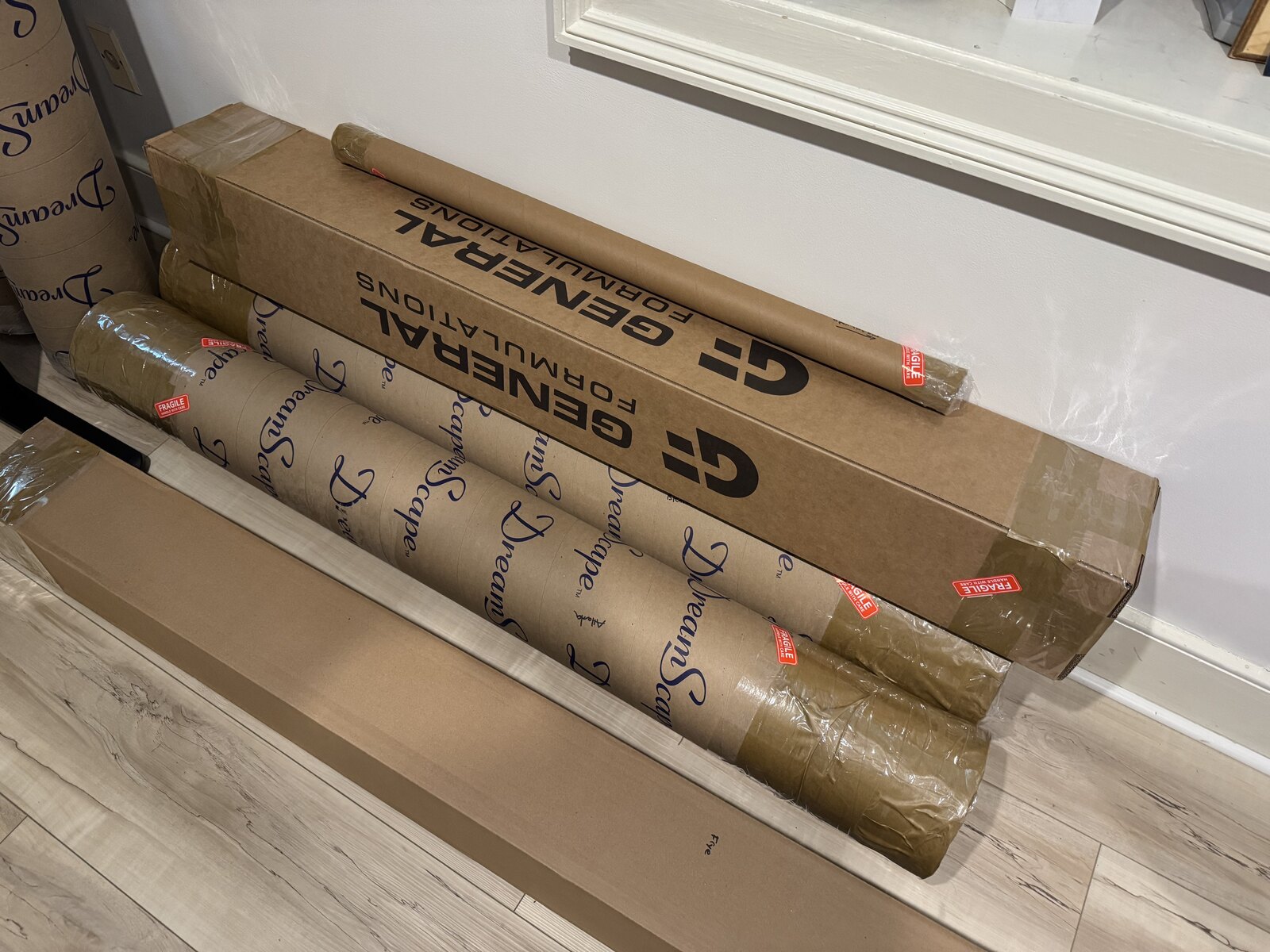
Staged for shipping, labeled and sequenced so the installers opened the right box first.
What This Project Taught Us
- Eleven designs is eleven jobs. Changeovers, not square footage, are what set the schedule on a multi-design run. Quote the stops, not just the print.
- Batch when the artwork is the bottleneck. Waiting for a complete set means the slowest contributor sets everyone’s delivery date.
- The overlap lives in the artwork. An inch of bleed cannot be added at the press, and a design built without it costs the installer a trim they should never have had to make.
- Plot every roll before the first one prints. A single birds-eye layout of the whole job is what turns eleven separate files into one production plan.
- Ask about the wall two months out. Paint sheen and cure time decide whether a self-adhesive vinyl holds, and both are someone else’s schedule.
- Sequence the shipments to the install order. On a fixed window, the order boxes arrive in matters as much as the date they arrive.
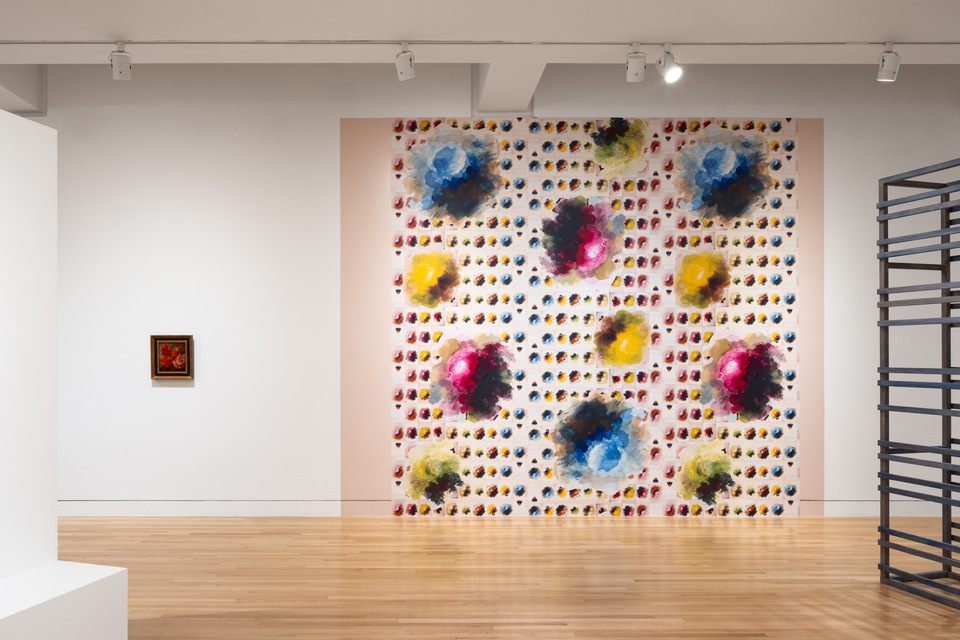
Installation view of Wallflowers, Frye Art Museum, Seattle, 7 February – 17 May 2026. Photo: Jueqian Fang.
Questions We Hear About Exhibition Wallpaper
Can you print multiple artist designs for one exhibition? Yes, and we will usually recommend batching them. Each design is its own setup on press, so sending artwork as it is finalized gets the early work printed while the later artists are still drawing. See our page for artists.
How wide are the panels, and how much overlap do we need? Our maximum printable width is 52″ on a 54″ roll. We recommend designing a 1″ overlap into each panel for a double-cut seam, which trims to 51″ on the wall. The overlap has to be in the file; we cannot add it at the press.
What file specs do you need? Layered PSD, TIFF or PDF at 300 ppi at final size — 200 ppi is workable on very large pieces — in CMYK or LAB with any Pantones called out, plus bleed. For a repeating pattern, include the repeat size. Our prepress team checks resolution, bleed and panel width on every file before production.
How far ahead should a museum book? Further than feels necessary. On this project the first inquiry was ten months before the opening, and the schedule was still tight, because artwork delivery — not printing — set the pace. Build in a proof round and a shipping buffer.
What should our walls be painted with? For a self-adhesive vinyl, eggshell, satin or semi-gloss, cured 14 to 21 days. Flat paint is porous and weakens the bond. Our guide to preparing wall surfaces can go straight to your installer.
Can you ship to meet a specific install date? Yes, and we will sequence the shipments to your install order rather than sending everything at once. Tell us which walls go up first.
Planning an Exhibition?
We print exhibition and gallery wallpaper at architectural scale for museums, galleries and institutions, from a single feature wall to an eleven-artist commission across multiple rooms.
Send us the designs, the wall dimensions and your installation dates. See our custom wall murals, or send us your project details.