Project
Custom Wallpaper Printing for a SoHo Restaurant: A Feature Wall at Manuela
Custom wallpaper printing for a SoHo restaurant: how we produced a feature wall for Manuela from a single painting in Lorna Simpson's Quiet Storm series, with material trials on Artist Canvas, one-layer versus two-layer saturation, a month of full-scale proofs, and a fixed installation date.
 By Steven D. Garcia
In the summer of 2024 we printed a painting by Lorna Simpson at mural scale, on Artist Canvas, for a restaurant that had not opened yet.
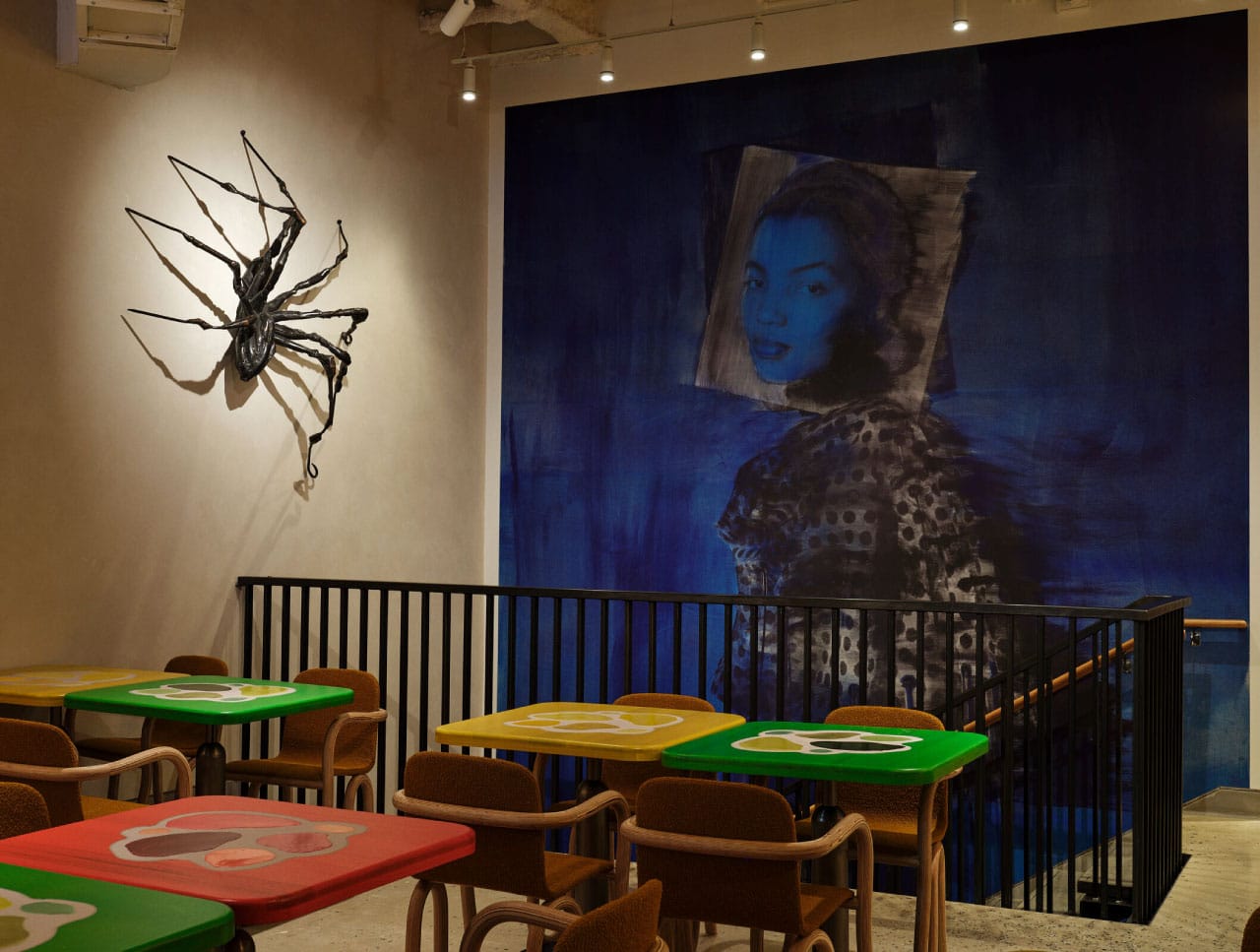
The source was a single painting from her Quiet Storm series, printed as a feature wall at 130 Prince Street in SoHo, at a budding restaurant called Manuela. The brief was easier said than done: make the printed wall read, just as the painting reads.
The reality was a lot more challenging. The painting had a strong and dark palette which did not photograph easily. The final file was 37 gigabytes. And the installers had a date that was not going to move.
The Restaurant
Manuela opened at 130 Prince Street in the fall of 2024, the first East Coast project from Artfarm, and named for Manuela Wirth, who founded Artfarm with Iwan Wirth.
It is a working neighborhood restaurant, with a seasonal menu cooked over a wood-fired grill, and it is also a room full of art. Mika Rottenberg built the bar from recycled plastic and harvested invasive bittersweet vine. Mary Heilmann made the ceramic tabletops. Louise Bourgeois’s Spider II holds one wall. There are murals by Rita Ackermann, Pat Steir, Uman, and Lorna Simpson.
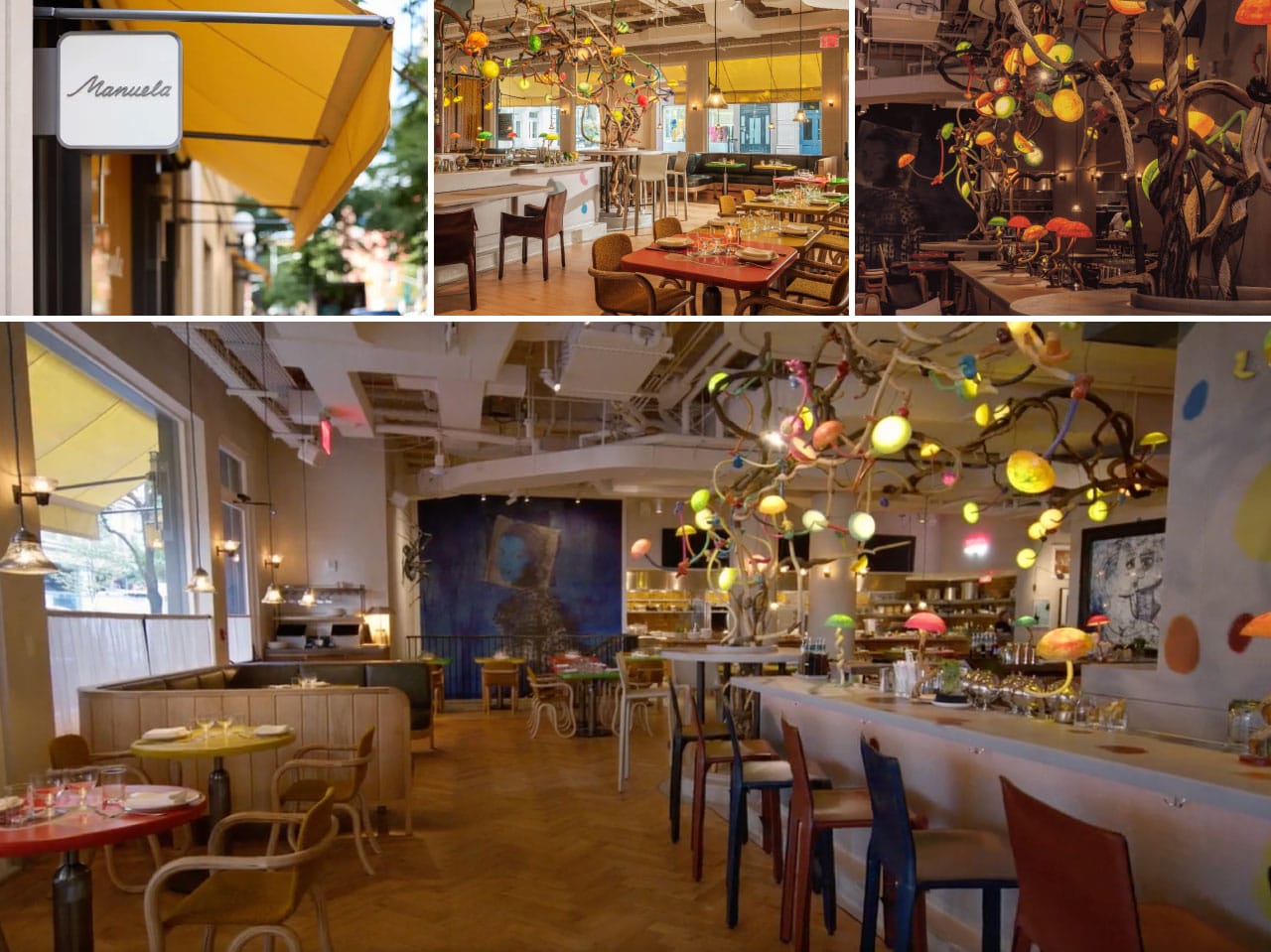
130 Prince Street: a restaurant built around the art rather than decorated with it.
That setting shaped the job. A mural in a gallery is looked at deliberately, under controlled light. A mural in a restaurant is seen from a chair, in daylight at lunch and in warm low light at dinner, by people who came for dinner. It has to hold up both ways.
Project Specifications
- Client: Lorna Simpson Studio and Hauser & Wirth, for Artfarm’s Manuela
- Artwork: one painting from Lorna Simpson’s Quiet Storm series (2024), supplied by the artist’s studio
- Original: found imagery from vintage Jet and Ebony magazines, digitally enlarged and screenprinted onto gessoed fiberglass board, then worked over in ink washes
- Palette: almost entirely blue, midnight through cobalt, navy and lapis
- Material: Artist Canvas — Dreamscape Type II commercial wallcovering, 20 oz, Class A fire rated, washable and scrubbable; requested by the studio and tested against the alternatives
- Proofing: four rounds of full-scale samples over roughly a month, from 24″ × 24″ panels to a 24″ × 144″ vertical strip
- Final artwork file: a single layered Photoshop file, 37 GB
- Installation: Jonathan Kutzin, 14–16 August 2024
- Our contacts: Jennifer Hsu, Lorna Simpson Studio; Max Price and Alex Bien-Aime, Hauser & Wirth
How the Job Reached Us
For several years we printed wallpaper for Rashid Johnson, starting in 2015 with Anxious Men at The Drawing Center. His studio manager, Alex Ernst, later introduced us to Hauser & Wirth.
Our first job for them was a conference room, in January 2024. Nothing about it was glamorous. We answered quickly, printed it, and sent a lamination proof before calling it finished. Later that year their art handlers came back with Manuela.
Why the Painting Was Hard to Print
The Quiet Storm paintings begin with found images from vintage Jet and Ebony magazines, superimposed and reconfigured until the face reads as something between a portrait and an apparition. We printed one of them.
How it was made is the whole technical problem. The image was digitally enlarged and screenprinted onto gessoed fiberglass board, then painted over with ink washes. Depth in a painting like that comes from layers of transparency, not from density of pigment.
A camera records that as a very dark file, with most of the detail crushed into the bottom of the range. Printed as captured, the wall goes black and flat. The washes stop reading as washes and become one dark field.
So this was not color matching in the usual sense. The work was to recover separation inside a narrow, dark, nearly monochrome blue, without inventing anything the artist had not painted.
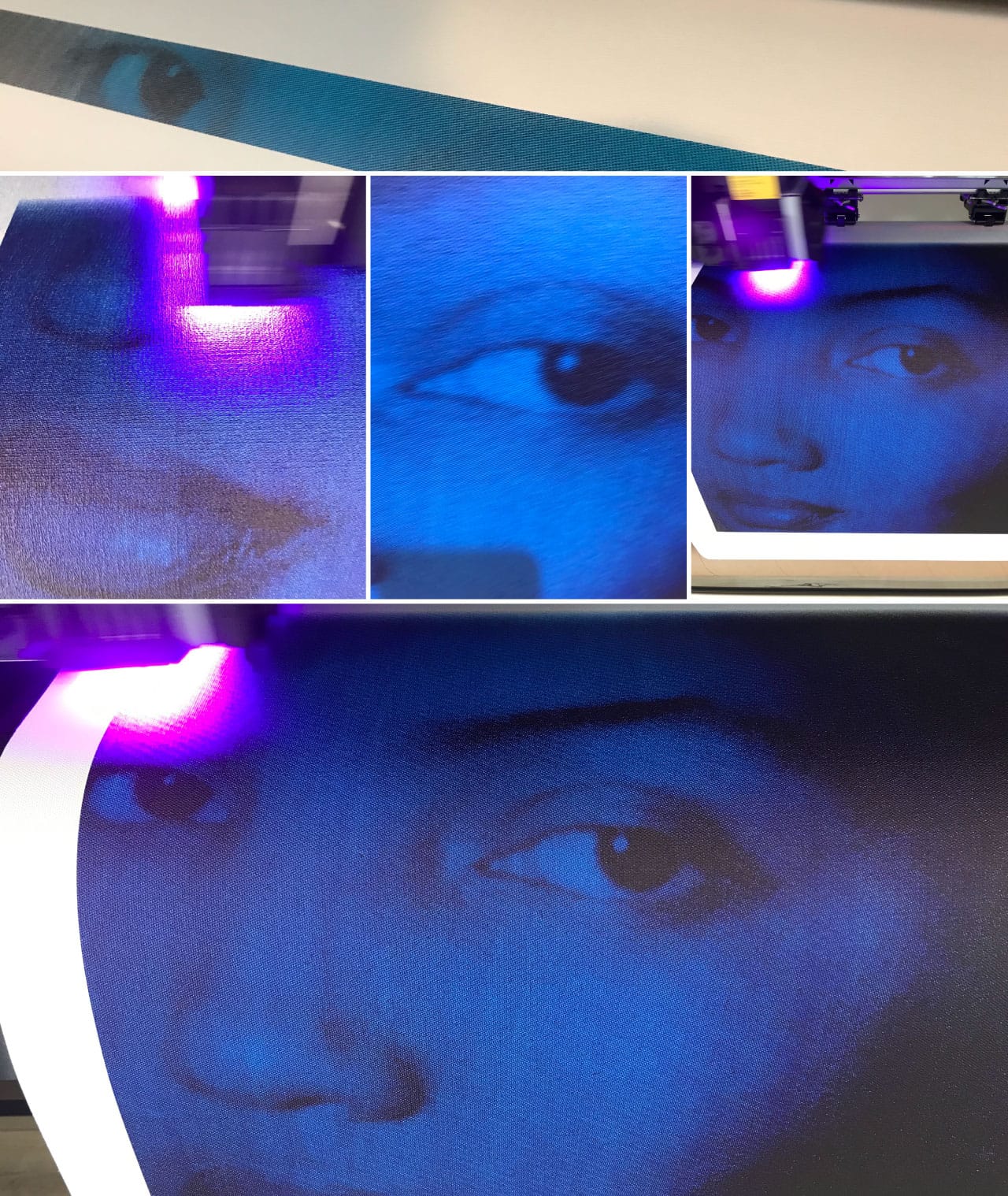
On press, and close to the surface: the canvas texture breaks the light and gives the washes somewhere to sit.
The Material the Studio Asked For
Artist Canvas was the studio’s call, and they made it early. They wanted a canvas surface, so that the wall would behave like a painting rather than like a print of one.
What was not settled was whether canvas belonged on a restaurant wall at all. The studio raised durability and longevity, and put real-fabric alternatives on the table — including screenprinting and hand-applying acrylics onto strips of raw linen, muslin or cotton duck, worked at the studio and rolled for transport.
The distinction matters, because the two paths are not the same product.
| Option | Pros | Cons |
|---|---|---|
| Artist Canvas (Dreamscape Type II) | A canvas texture with commercial performance behind it: 20 oz fabric-backed vinyl, Class A fire rated, washable and scrubbable, built for high traffic | Had to prove the texture read as canvas and not as a print of one |
| Poly-cotton artist’s canvas | Literal woven fabric, and already in the studio’s own supply | An artist’s material rather than a wallcovering: no backing, no rating, unproven on a wall |
| Raw linen, muslin or cotton duck | The artist could work the surface by hand at her own studio | Same gap, plus untested at this scale against a fixed install date |
Fire code was part of this, and the studio raised it early: they asked whether Manuela had requirements for the material, having heard that a fireproof version existed but would change the look and feel of it.
With Artist Canvas that trade never had to be made. It is a commercial-grade Type II substrate, Class A fire rated and building compliant, so the surface that suited the painting was also the one that suited a public dining room. The real-fabric options could not say the same.
Rather than argue the point, we printed and let the samples settle it.
One Layer or Two
With a file this dark the instinct is to lay down more ink. We printed the Artist Canvas both ways, single-pass and double-pass, and included a proof on a second material the studio had not asked for, at no charge, so the comparison was real rather than leading.
Every proof went out annotated on the reverse, in the upper right-hand corner, marked one-layer or two-layer. The studio had told us in plain terms why that mattered:
“I can see differences in color, but wanted to clarify if these are different materials or different printing processes.” — Lorna Simpson Studio
The saturation tests ran over a weekend, and the answer was the opposite of the instinct: double saturation was not necessary.
Then the studio confirmed its own first instinct. Of everything we had sent, the single-layer Artist Canvas was the closest match, and that is what went on the wall.
Proofing at Full Scale
Every test was printed at 100%. On a mural a scaled-down proof hides the grain of the canvas, compresses the washes and flatters the contrast, which means it answers the wrong question.
The studio chose its sample regions deliberately, sending areas of the painting picked to test contrast, shadow detail and the darkest passages.
Four rounds ran across roughly a month: a first set of 24″ × 24″ panels at full scale, three more panels chosen for contrast and shadow detail, a second batch after the saturation question was settled, and finally a 24″ × 144″ vertical strip — twelve feet of the painting in one piece, which is the only honest way to see how washes behave over the height of a wall.
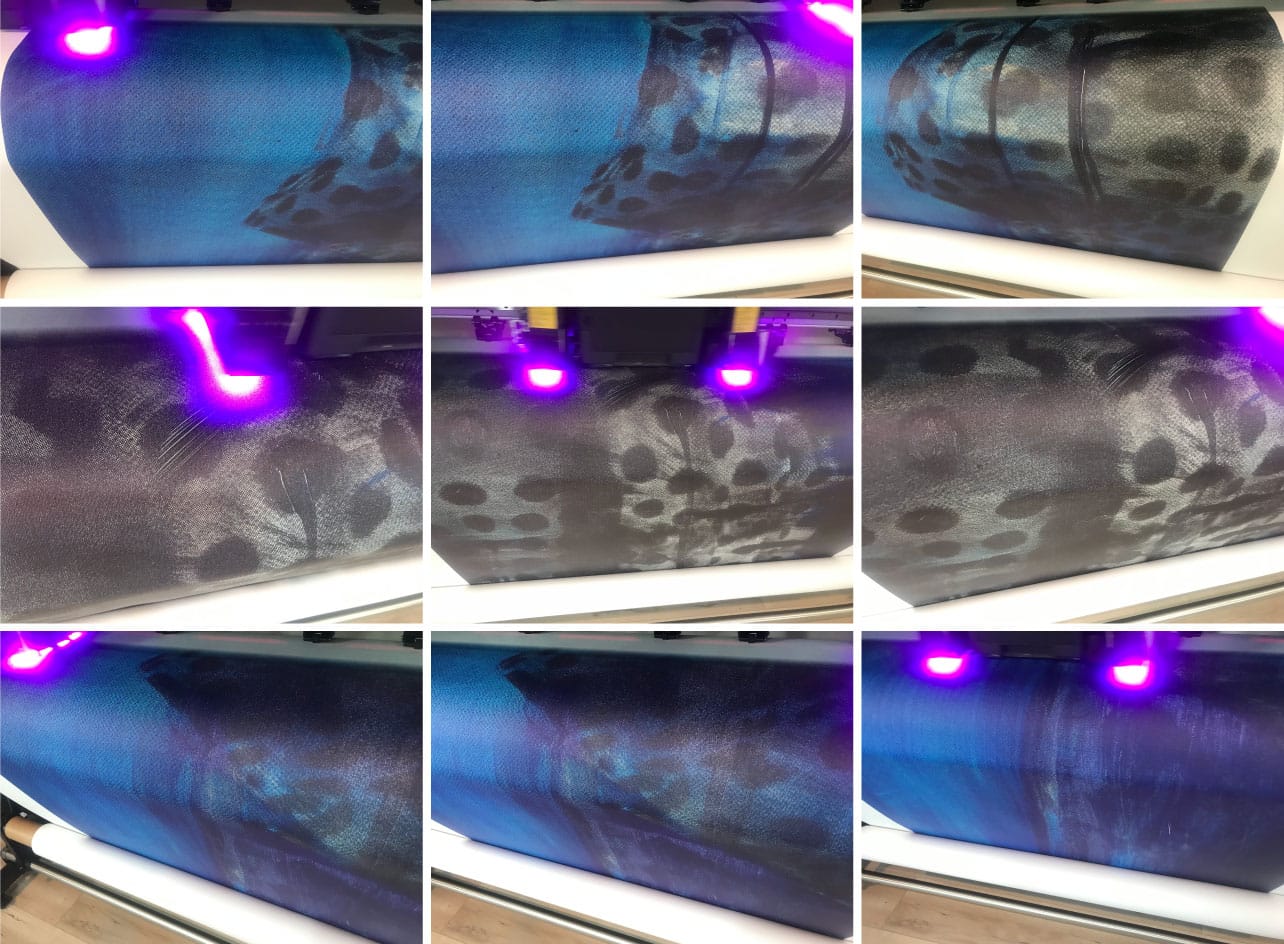
Passages chosen to break it: the darkest fields, the patterned garment, and the edges where one wash meets another.
Between those rounds we adjusted contrast internally several times, and those rounds never left the building. What reached the studio was work we already believed in, and every piece of it was a press proof on the real material.
The Final File
On 7 August the studio sent the approval and the artwork in the same message:
“Thanks again for the last sample, it looks great. And thank you and your team for adjusting and working with us to get this just right, Lorna is very happy with the result.” — Lorna Simpson Studio
The final artwork arrived as a single layered Photoshop file of 37 GB.
A file that size is not something you casually open. Download, verify, open and RIP each stop being a click and become a scheduled operation, and any one of them failing quietly overnight is a missed installation date. This is the part of large-format printing that nobody photographs and every production manager asks about: whether the shop can take an artist’s final file at full fidelity, intact, and turn it into material on a deadline.
The Date That Could Not Move
Underneath all of it was a restaurant opening. On 5 August, with installation booked for that Friday, the ask was specific:
“Is it possible to print this final test today, overnight for delivery tomorrow and print the final file on Wednesday/Thursday?” — Lorna Simpson Studio
We took the updated file and started printing the new strip that afternoon. The finished piece shipped direct to Prince Street rather than through the gallery, which saved a leg.
Then the installer’s other job ran long. He needed the 12th and 13th to finish and clean up, so the window moved to 14–16 August, and the print and delivery schedule moved with it. That ran across a thread carrying the artist’s studio, the gallery’s registrars and art handlers, the installer and us: about a dozen people across four organizations, all of whom needed the same answer at the same time.
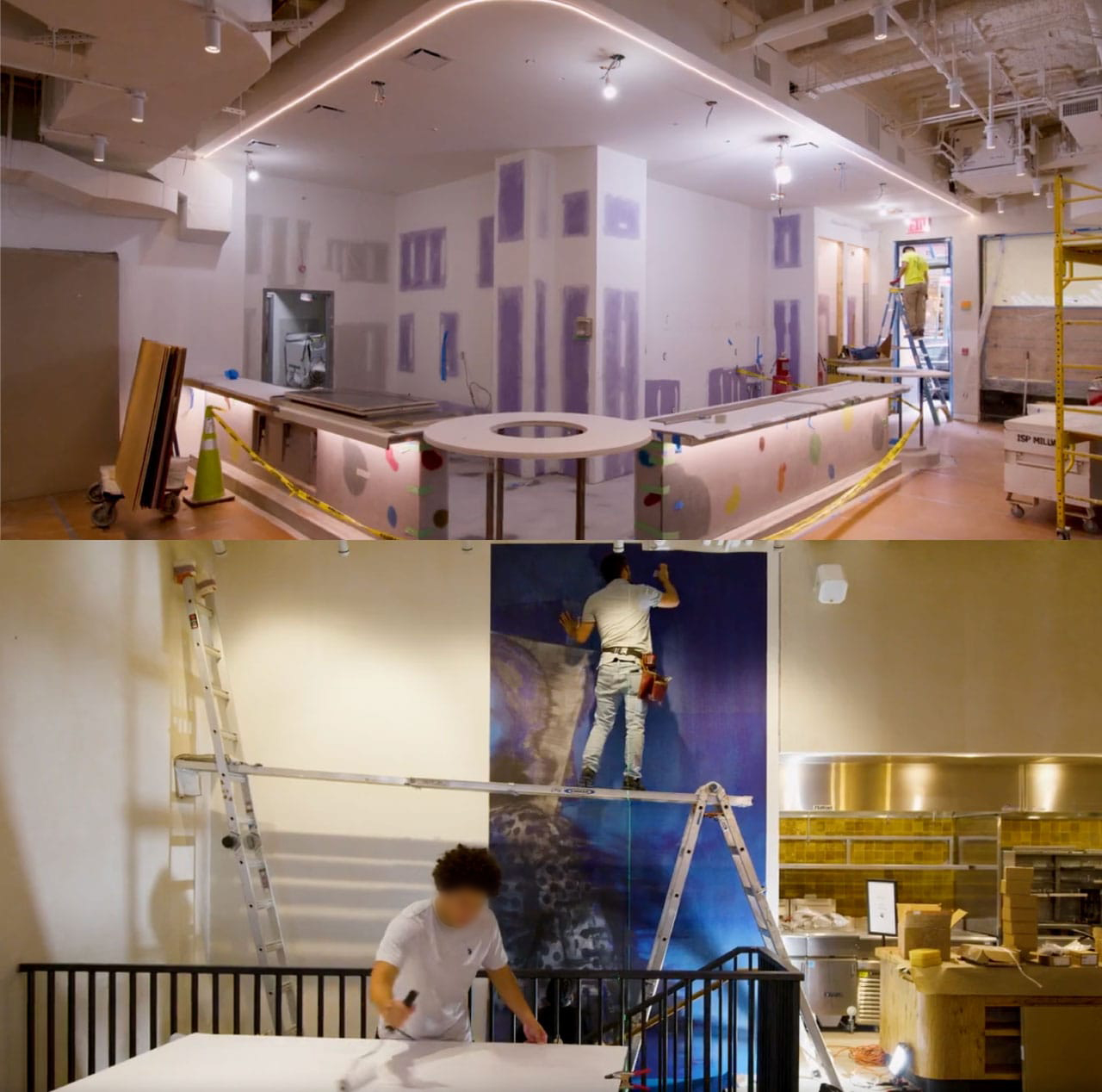
14–16 August 2024, with the restaurant still a building site around it.
After the Wall Went Up
A restaurant wall gets touched. That October we sent the gallery a written cleaning and maintenance protocol: mild soap and warm water, washing from the bottom up and rinsing from the top down so dirty water never streaks the panel below, a soft lint-free cloth to dry, no abrasives, no solvents, and never mixed cleaning agents.
We also recommended a protective topcoat rather than leaving the question to be discovered later. A water-based, non-hazardous coat gives a high-traffic wall real resistance to scuffs and stains. On an artwork the decision is not ours to make, so we named the product, set out what it would and would not change, and left it with them.
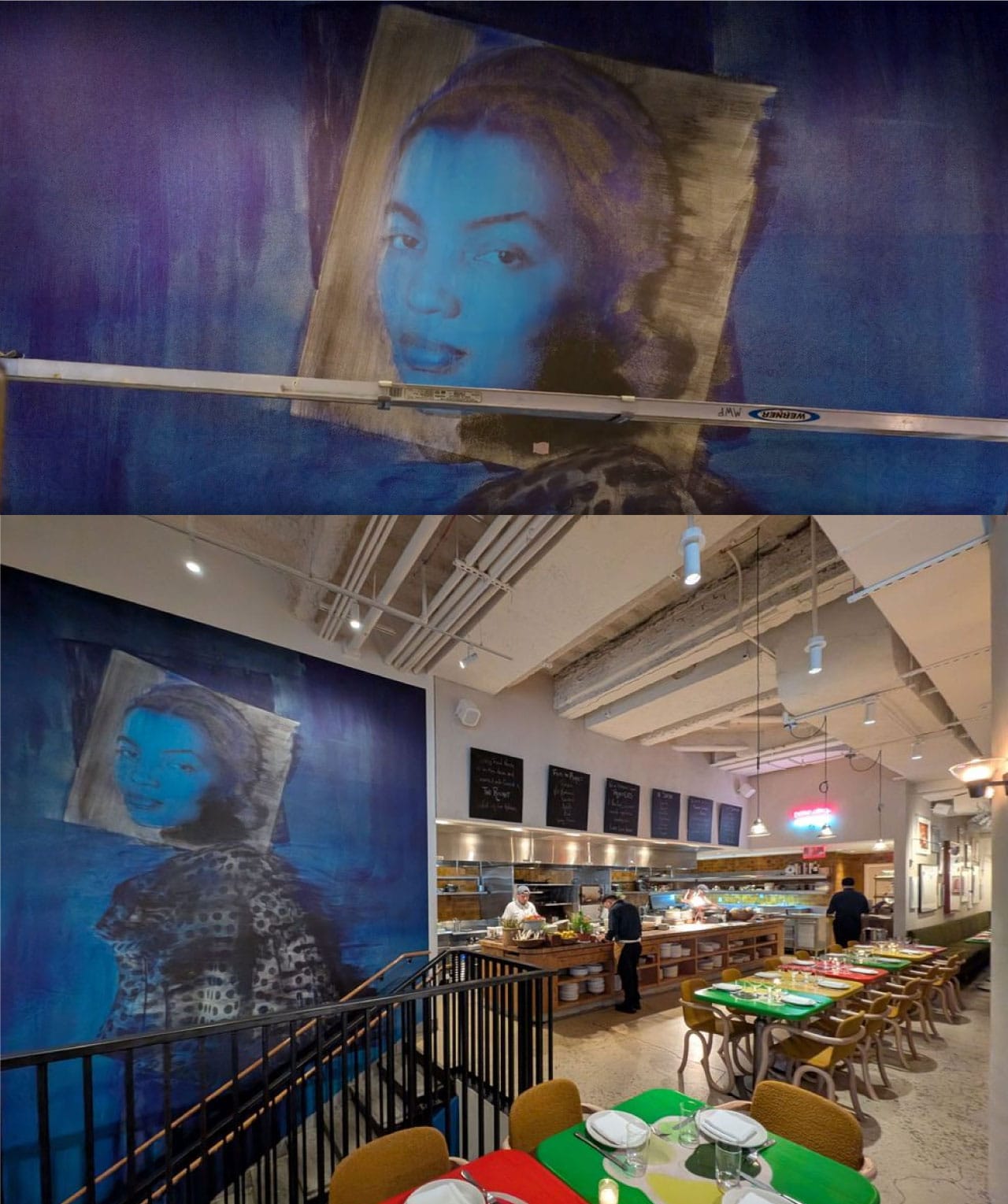
In the room it was made for, seen the way the restaurant actually sees it.
What This Project Taught Us
- Proof at the size it will be seen. A 24″ × 144″ strip answers questions a 24″ × 24″ panel cannot, and both answer questions a scaled proof actively hides.
- More ink is not more depth. The single pass beat the double, and the samples settled it before anyone had to argue.
- Label everything you ship. A proof with no notation on the back is not evidence, it is a guess with a courier charge attached.
- Absorb the internal rounds. Several contrast passes never left our building. The client’s time went on decisions, not on watching us iterate.
- Settle the substrate rating before the aesthetics argument starts. Artist Canvas is Type II and Class A, so the surface that matched the painting was also the one the building required. That is not always true, and it is cheaper to know early.
- The logistics are the deliverable. Color is why they called. Receiving 37 GB intact, printing overnight, shipping to the right address and moving the whole schedule when the installer moved his is why the wall was up when the restaurant opened.
Questions We Hear About Feature Walls
Can you print my painting at mural scale? Yes. We print from a photograph or scan of the work, proof it at full size on the actual material, and adjust until it matches. Supply the highest resolution you can: at least 300 dpi at final print size. See our page for artists.
Can you print on a canvas surface that still works in a commercial space? That is exactly what Artist Canvas is for. It is a Dreamscape Type II wallcovering — 20 oz fabric-backed vinyl with a canvas texture, Class A fire rated, washable and scrubbable. Raw artist’s fabrics give you literal weave and nothing else: no backing, no rating, and no track record on a wall. We will sample both beside each other so the decision is made on evidence.
My scan looks too dark. Can that be fixed in print? Usually. Dark paintings built from transparent layers photograph badly, and the detail sits crushed in the shadows. The work is recovering separation without inventing anything, and it is done with printed proofs judged against the original, not with adjustments on a screen.
How many proof rounds should we expect? On a straightforward reproduction, two. On a dark, near-monochrome painting like this one, plan for four full-scale rounds across about a month, and build that into the install date. Our color matching process is the same in either case: printed options, judged in the light where they will hang.
How large a file can you handle? Larger than most. The final artwork here was a 37 GB layered Photoshop file. Send the file at full fidelity rather than flattening or downsampling it for us.
Will it survive a restaurant? Yes, with the right material and care. We supply written cleaning guidance, and where a wall takes heavy traffic we will set out the protective topcoat option. On an artwork, that decision belongs to the artist.
Planning a Feature Wall?
We print feature walls at architectural scale for restaurants, hotels, offices, galleries and private homes, on wallcovering substrates and on Artist Canvas, from your artwork or ours.
Send us the image, the dimensions of the wall, and the date it has to be up. See our custom wall murals, or send us your project details.