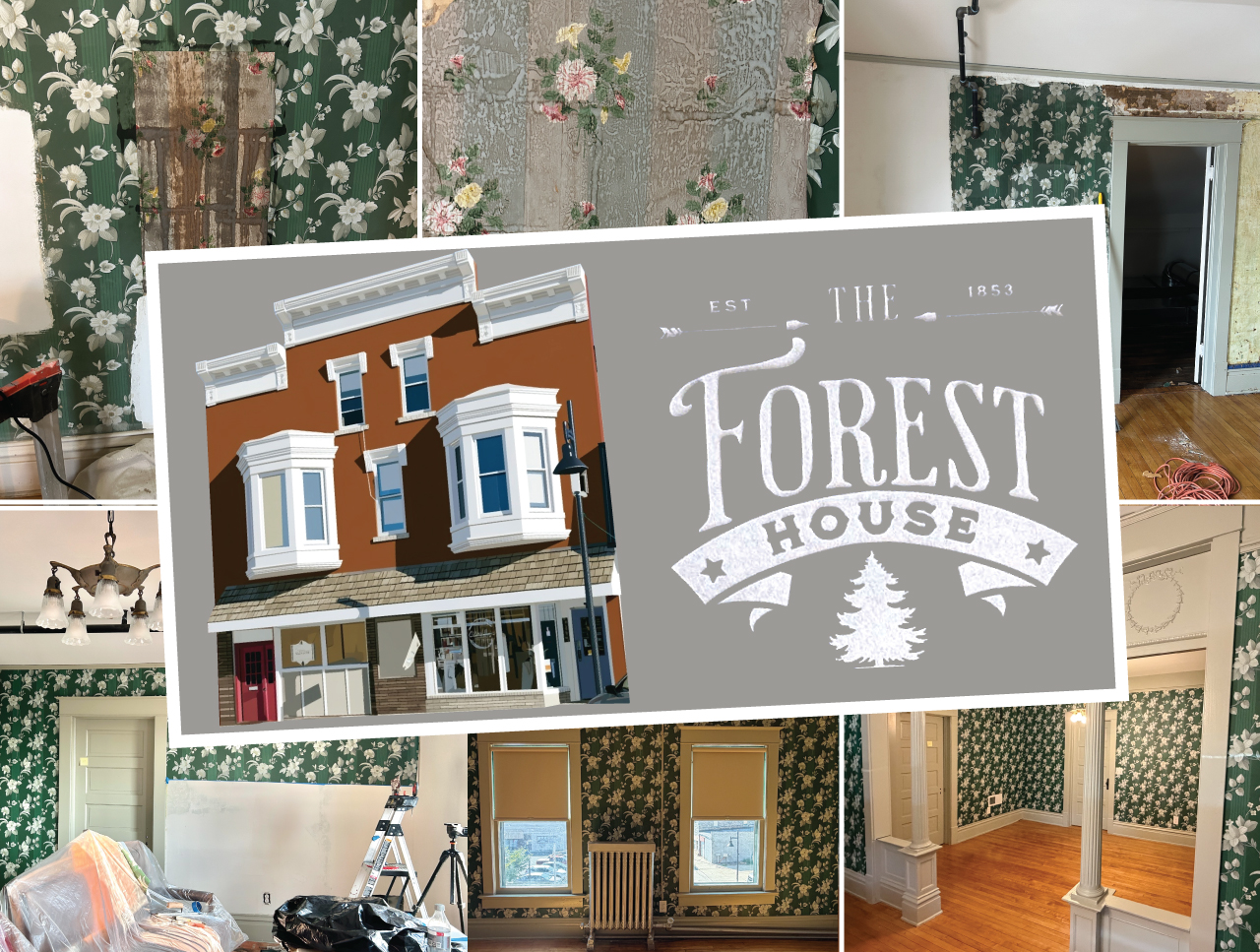
The Discovery
Three layers of wallpaper. One third-floor room. A century of accumulation.
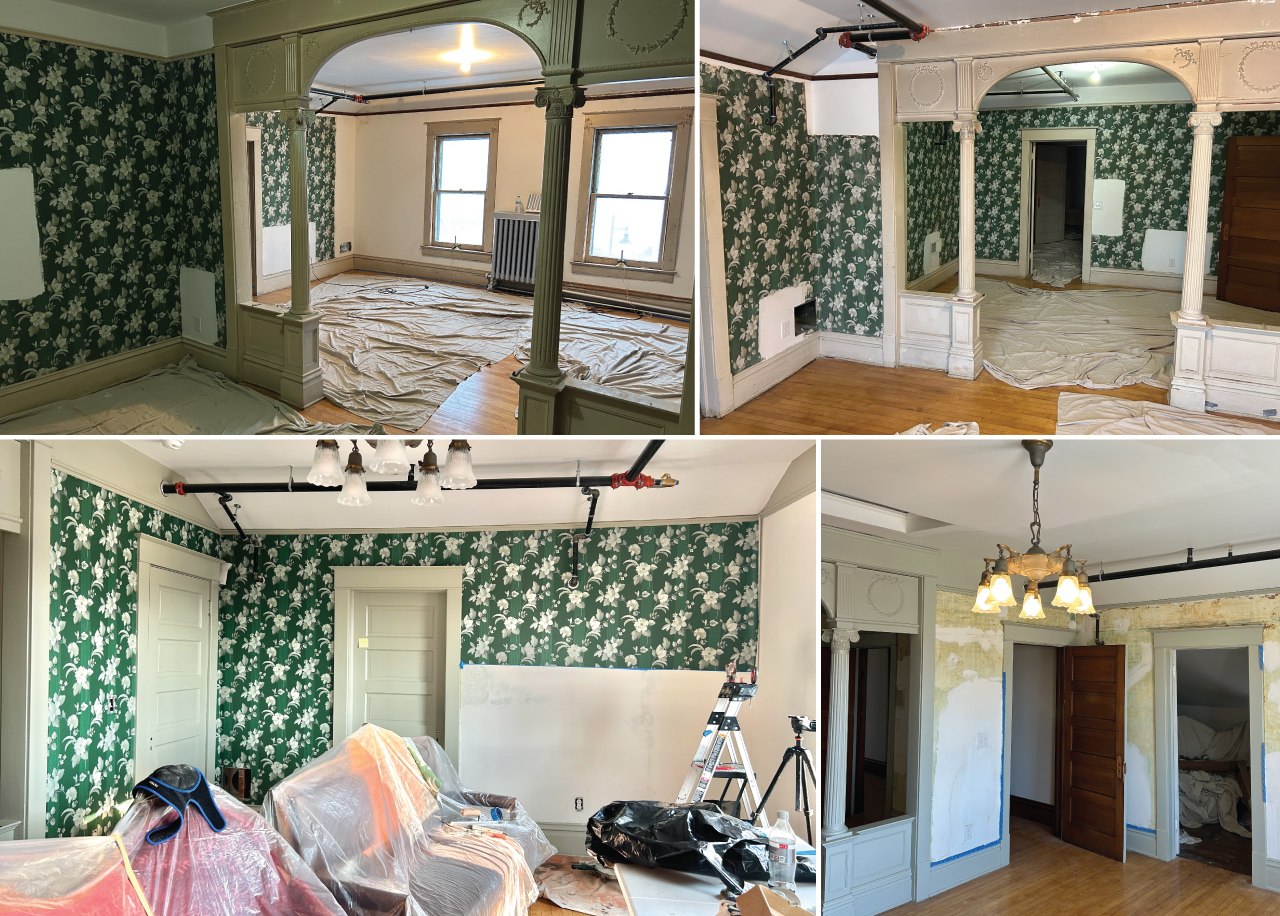
When the Historical Association of South Haven began restoring the Forest House, they peeled back the walls of an upstairs bedroom and found exactly that: a deep-green floral pattern on top, and beneath it, two older papers still — one with trailing flower stems, one with Asian motifs.
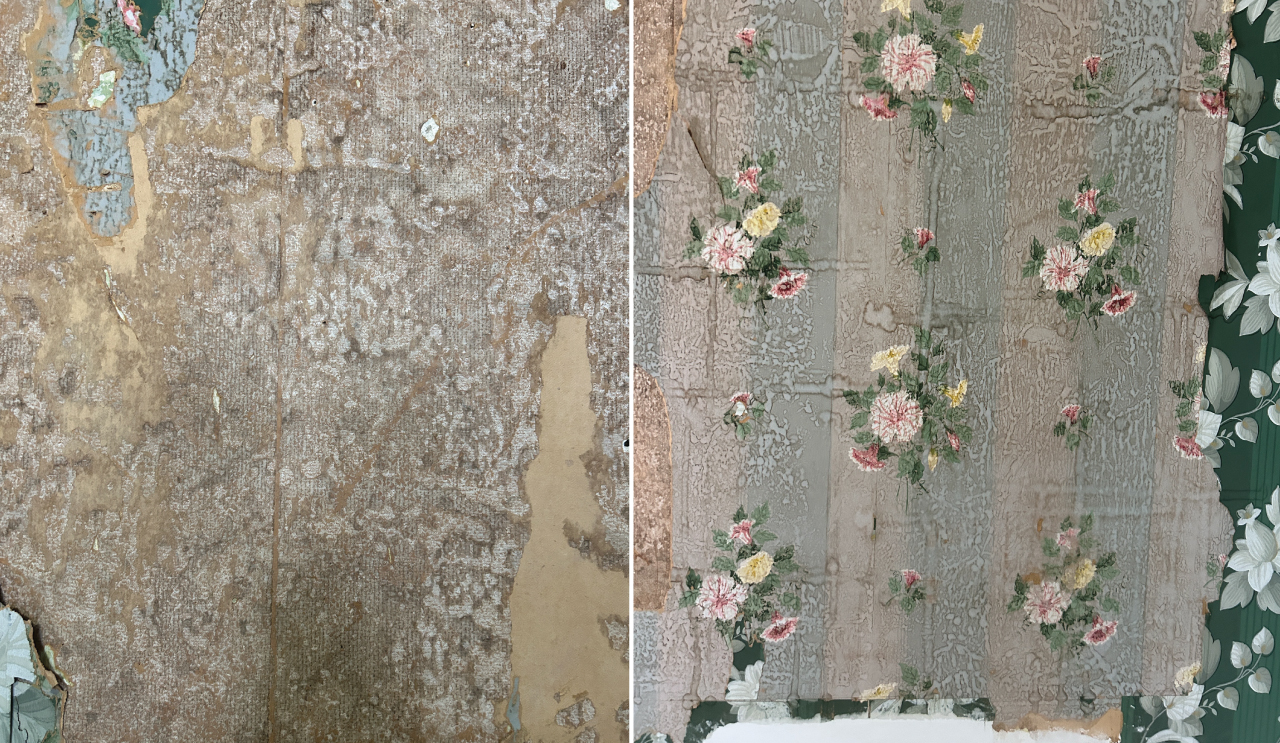
The older papers were too fragile to save; they came away in crumbles. But the green floral — full, pale blooms scattered across a deep-green ground — had survived in enough places to be recovered, rebuilt, and reprinted.
We were asked to bring it back.
The Challenge
The green floral wasn’t just faded; it was severely damaged. The surviving fragments were covered in stains, tears, and blemishes, and certain portions of the pattern were completely missing, requiring us to rebuild them entirely by hand.
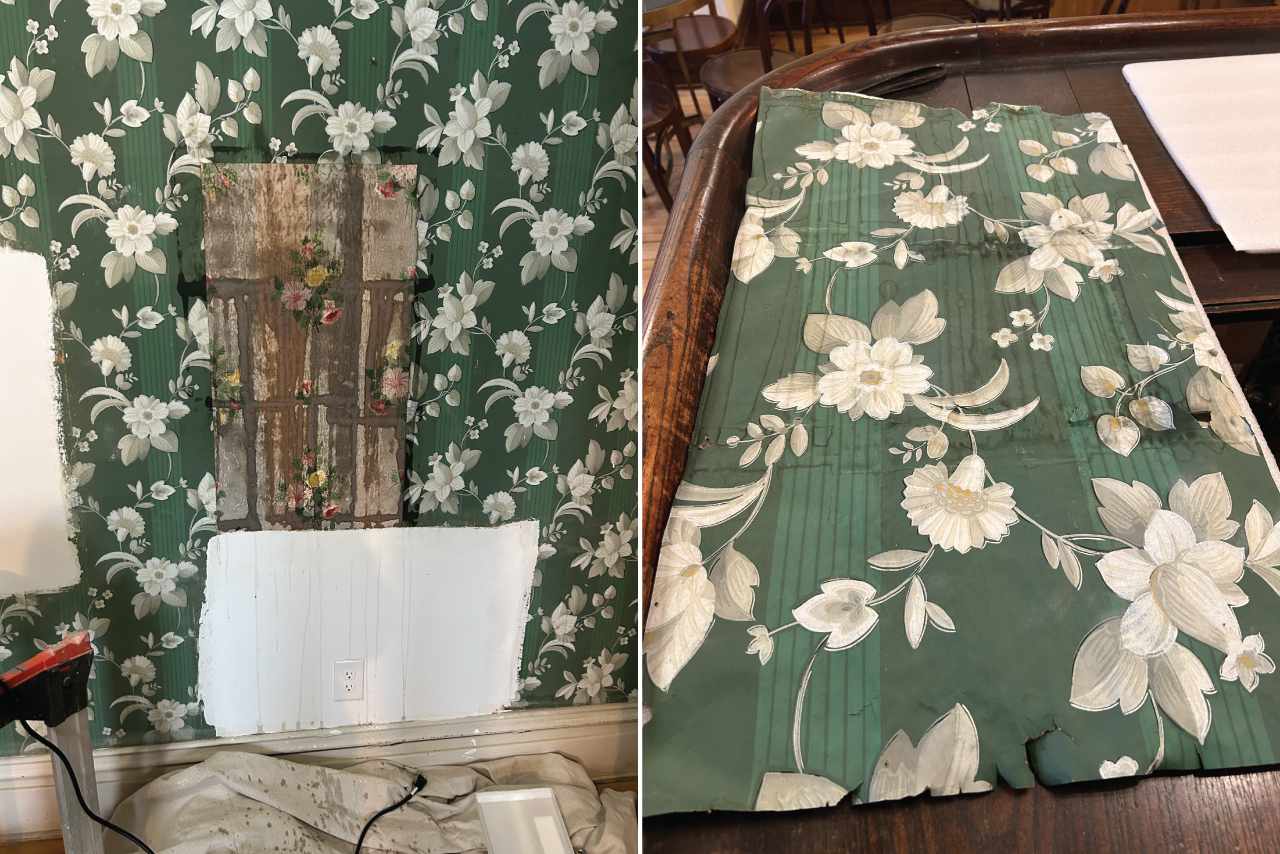
Because those upstairs rooms only came into being with the 1906 remodel, the paper dates to the 1910s–30s, from the years the building operated as a rooming house. This wasn’t a forensic museum reproduction. The Historical Association is preserving the look and feel of a 1906 landmark for a historical-tourism destination. The paper needed to be true to the room’s character rather than to the last faded fiber.
The Recreation
Digital Reconstruction
We rebuilt the pattern digitally from what survived. The design was clip-masked completely from the background, which is where the most intensive surgery took place.
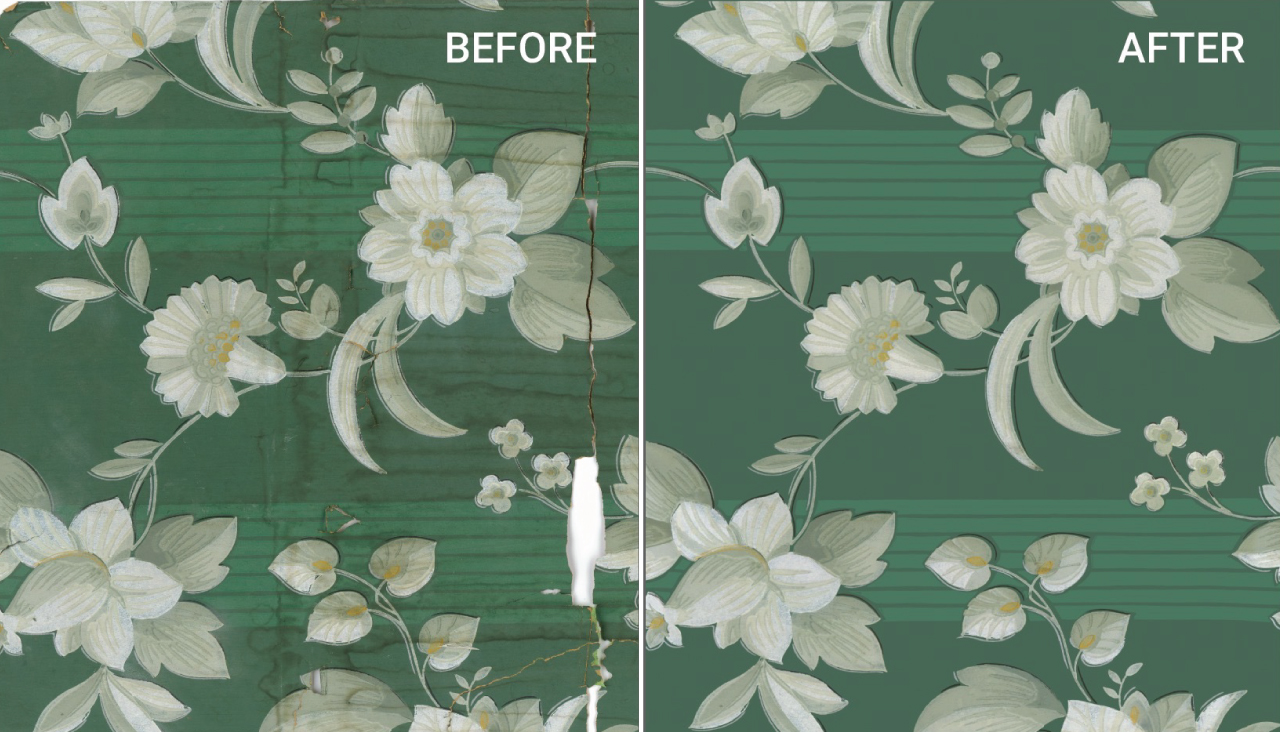
We spent hours removing stains and ensuring the color distribution was uniform before even attempting color separation. We also ensured that the edges lined up perfectly for a seamless motif repeat across the entire roll.
Hand Tracing & Color Separation
This is the part of the process nobody thinks about. In order to gain total control of the colors they must first be isolated into their own adjustable layers. Even in today’s age of advancved AI, there is no magical app that can do this. The process requires human intervention from an expert.
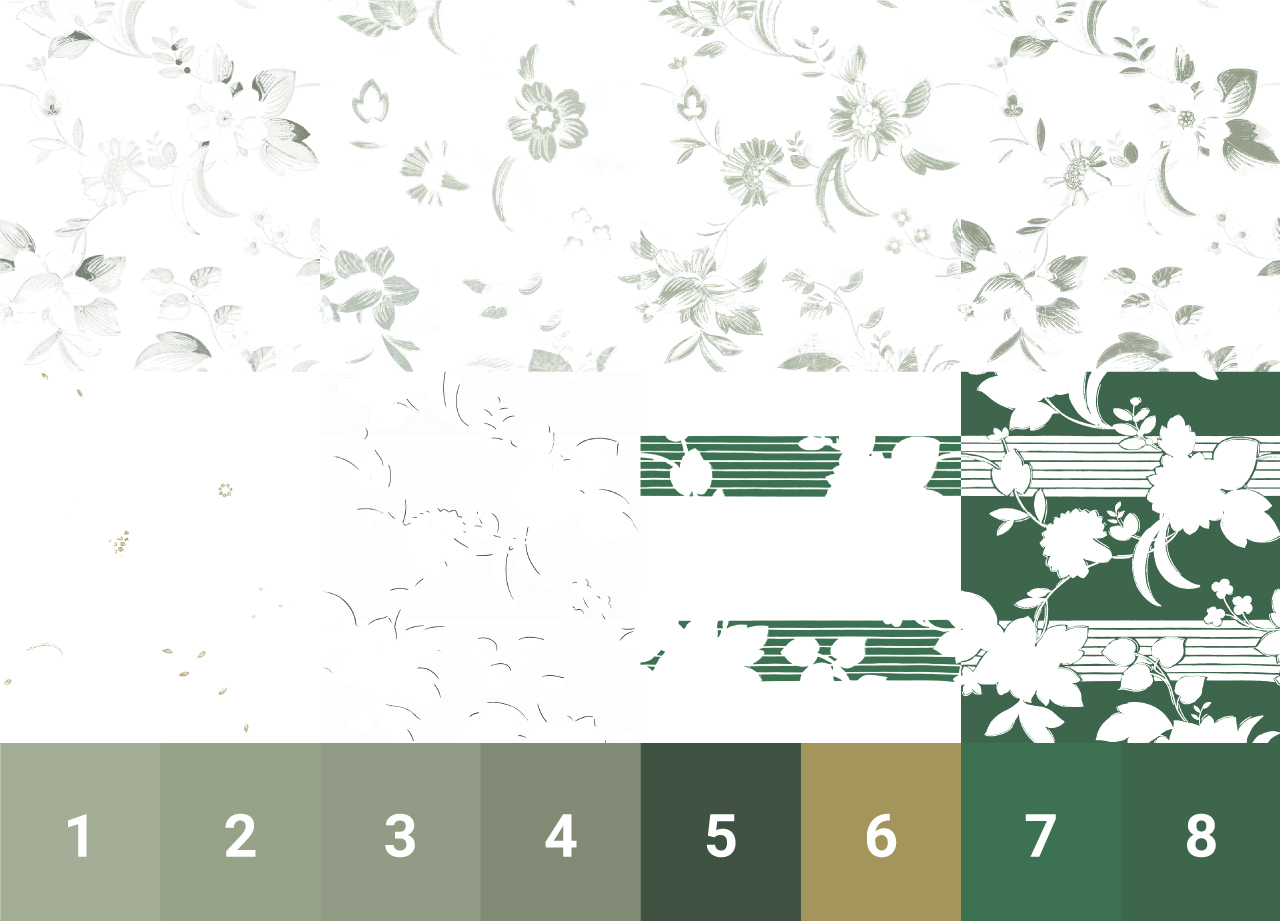
To gain mastery of the entire palette, we hand-trace every single shape so it can exist in it’s own world of calibration. This allows very fine tuned and targeted controls across the full pattern.
The 0.1% Color Match
Color is where a recreation lives or dies. The deep-green background was straightforward, but the real challenge was the flowers, which featured a greyish-silvery tone.
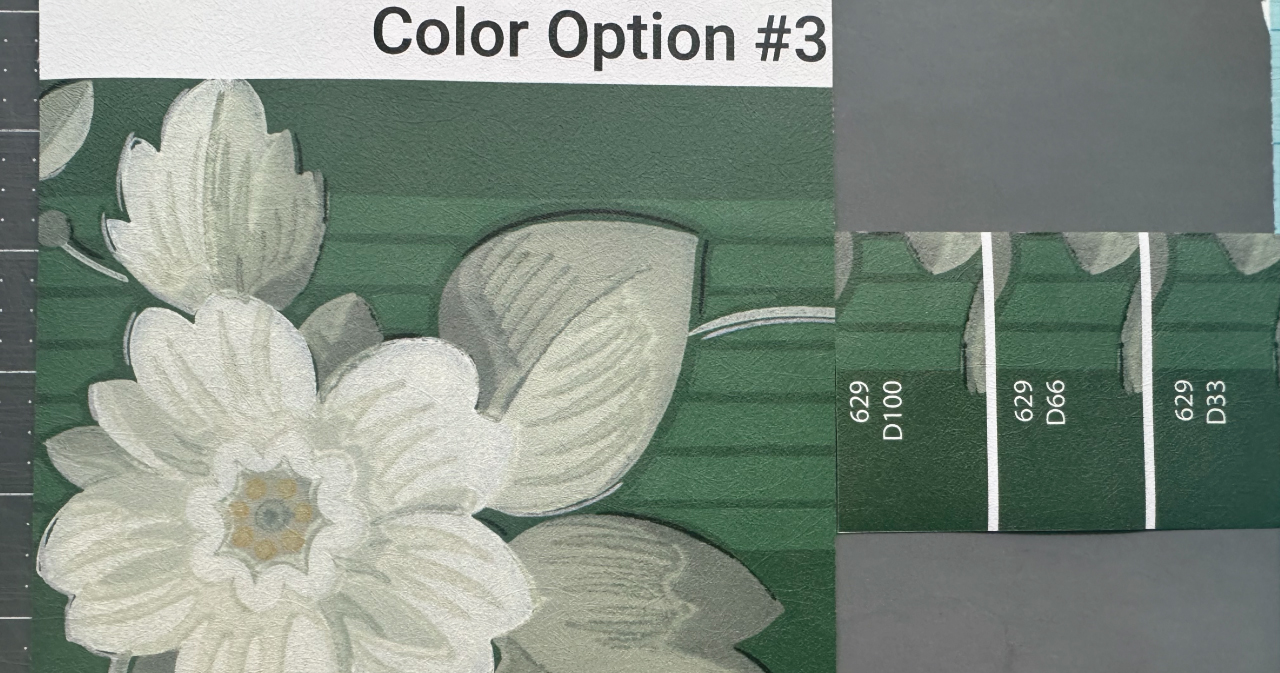
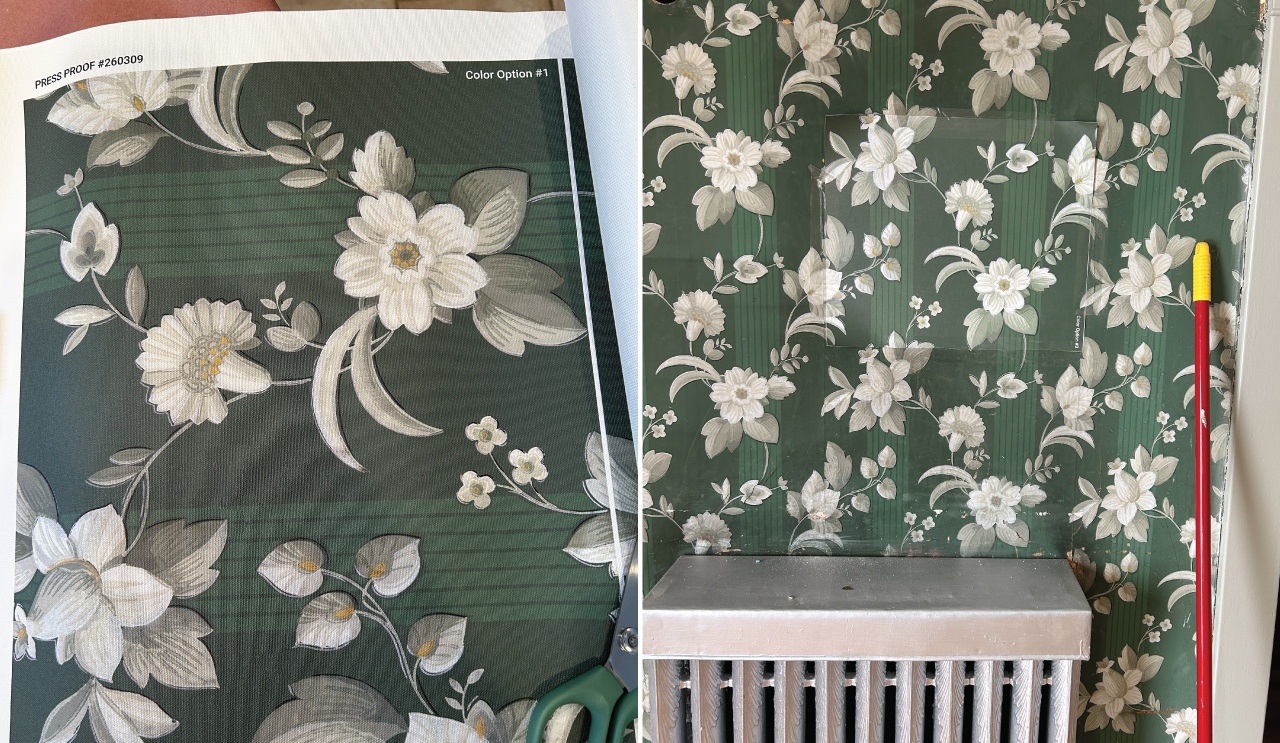
Grays and neutrals are notoriously sensitive in print; even a 1% change in ink density is clearly visible to the eye. To get it right, we had to move in 0.1% increments, resolving the colors on our internal color tests and judging them in context. We went through three rigorous rounds of physical proofs with the client until the soft silvers and deep greens were perfectly locked in.
Substrate Choice
The finished paper was printed on Mystical, a Dreamscape wallcovering substrate. James Ollgaard had been weighing it against a cotton stock, but chose Mystical for the way it made the greens and neutrals pop. Our production manager, Joseph, talked the choice through with him to ensure it met the durability requirements for a public historic space.
The Installation: Where Craft Meets Art
Our part ends at the finished roll; the hanging belongs to the installer. At the Forest House, that installer was William Suran, a graduate of the Kansas City Art Institute and owner of WS Wallpaper and Finishes.
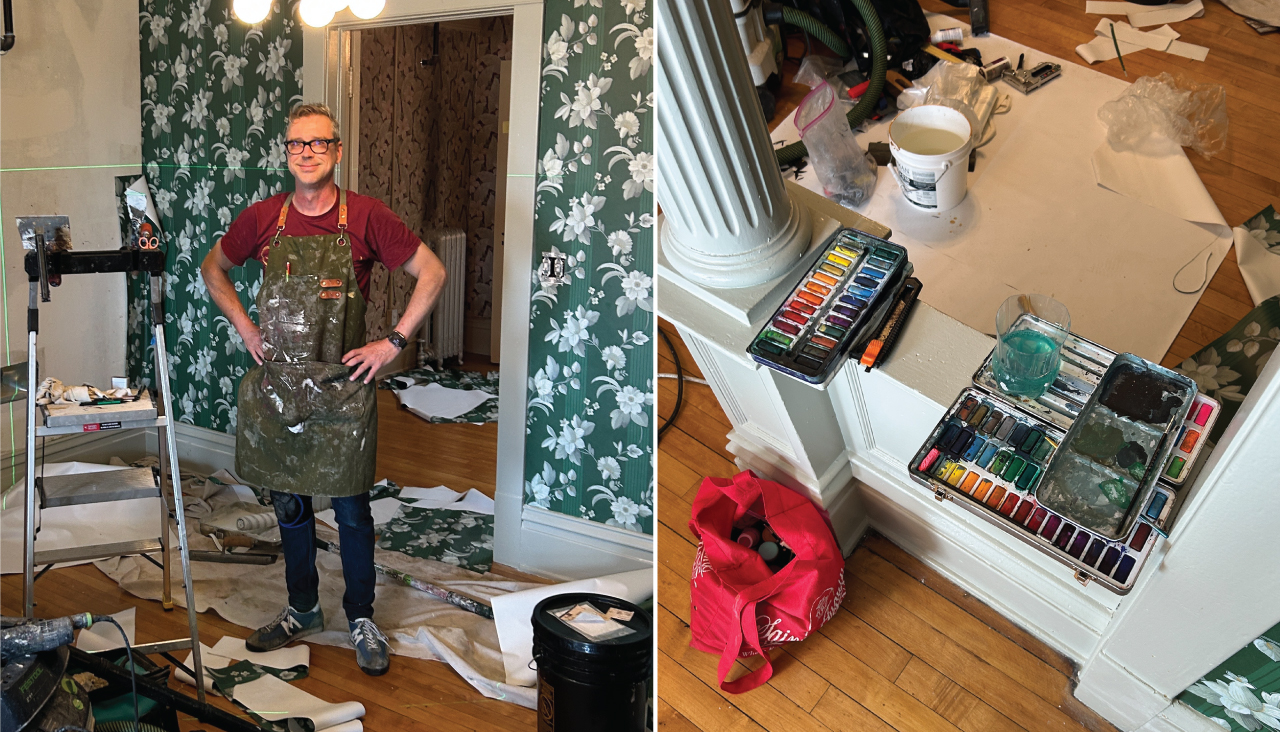
Because the old bedroom had irregular wall margins, William didn’t just hang the paper. He also painted in the odd-shaped gaps near the ceiling and floorboards, mixing a perfect match of the green background to seamlessly fill those tiny spaces. His ability to adapt to the quirks of a 19th-century building turned a great installation into a flawless one.
The Building Behind the Wallpaper
The Forest House is South Haven’s oldest building — the town’s first hotel, built in 1853 on the first high ground south of the Black River. It took its name from the forest it stood in, and its top floor was a full-length ballroom that doubled as the town hall.
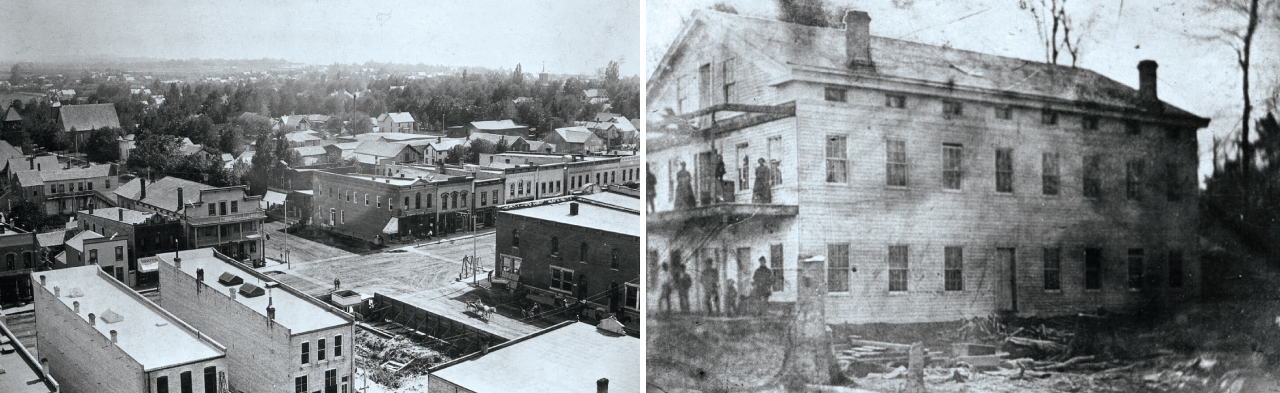
Photo Credit: Historical Association of South Haven circa 1892
In 1895, the building was nearly lost altogether. An 1890 fire had pushed the town to rebuild in brick, and the owners had the entire three-story structure lifted and moved down the block to face Center Street. The displaced hotel was stripped of its porches and put to work as a livery stable.
In 1906 it was remodeled into the shape it still holds: two retail spaces at street level with rooms above. Over the decades that followed, those upstairs rooms were let out as lodgings and then apartments, papered and repapered. Local rumor holds that a traveling wallpaper salesman once lived in the building — a story that would perfectly explain the layer upon layer of paper the Association found upstairs.
The Result
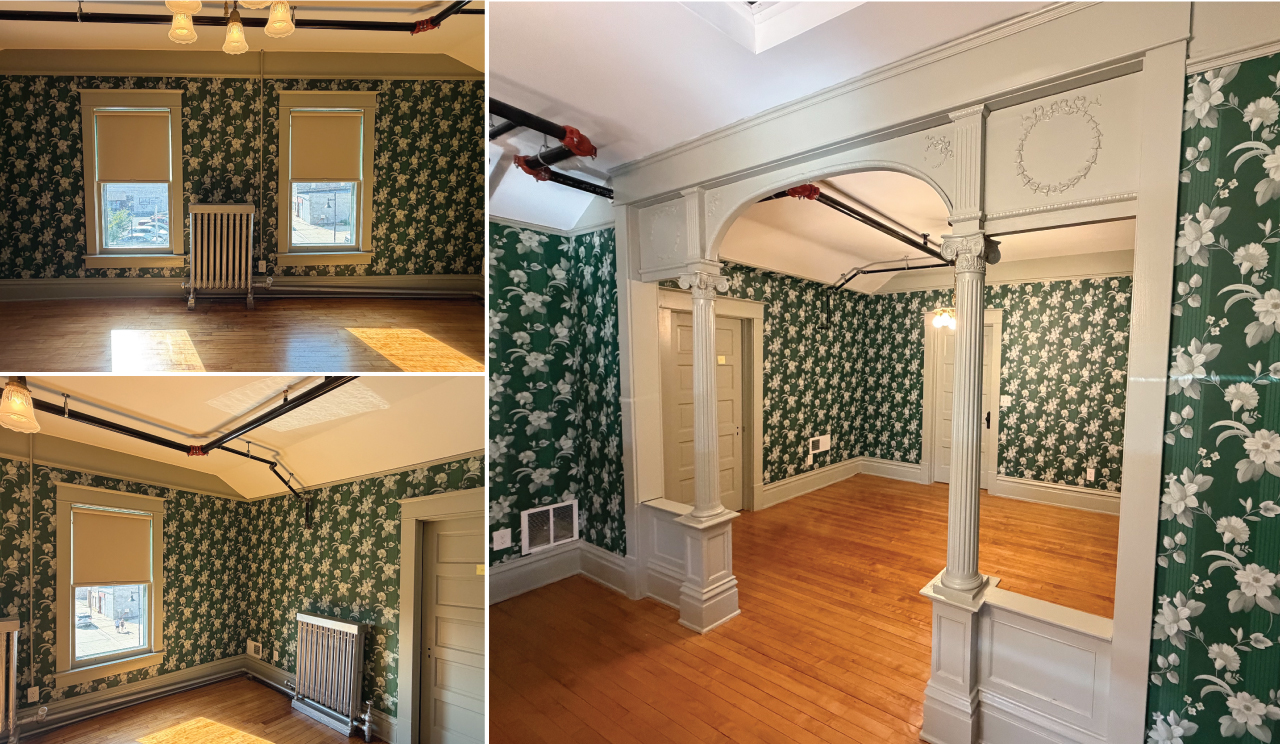
The recreated green floral is back on the third-floor wall now, hung seam by seam.
Behind the Forest House restoration is a man who has spent most of his life on exactly this kind of work. James Ollgaard has led the Historical Association of South Haven for most of its twenty-four years. He came to antique wallpaper with a liberal-arts degree, an insatiable curiosity, and, in his own words, no more experience than “putting it on my walls.” What he brought instead was the eye of someone who has spent two decades learning to read a building.
“My impression of the print quality is that it is impeccable.” — James Ollgaard, President, Historical Association of South Haven
“It’s really amazing that you guys got the wallpaper looking like it did 100 years ago.” — James Ollgaard, Historical Association of South Haven
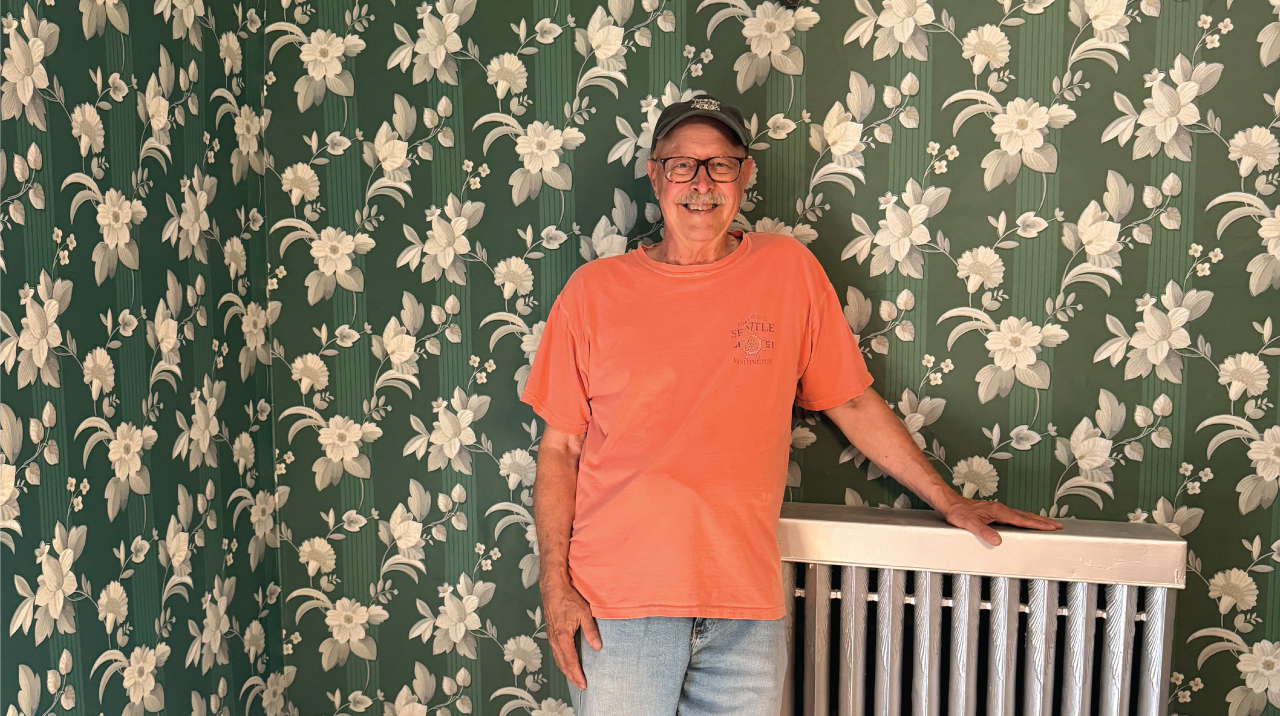
We want to thank James directly for his collaboration and his excellent documentation of this project. It was a joy to work with someone so dedicated to the preservation of art, culture and history.
A Room in the Town’s Story
The Forest House is reopening as part of South Haven’s long turn from a lumber town to a lake resort — the arc the whole town rode, from sawmills and schooners to the Chicago steamships that still bring summer crowds. Downstairs, in a new tavern carved from one of the old retail spaces, a feature wall keeps the building’s layers on display: exposed brick, the original cornices, and framed fragments of the very papers this story is about. Upstairs, the green floral is back on the wall it left.
The building is being brought back by the Historical Association of South Haven — you can follow the project at historyofsouthhaven.org.
Questions We Hear From Historical Societies and Building Stewards
Can you reproduce wallpaper from damaged or incomplete samples? Yes. Missing and damaged sections are the heart of what we do. We reconstruct the absent portions of a motif by reading the pattern’s underlying geometry and its period design language, rebuilding lost elements to match the original.
Can you match the original colors of a faded pattern? Yes, within the honest limits of the medium. We resolve every color on our four-color process, bracketing against an extensive internal reference library and running multiple calibration proofs, and we can set the finish anywhere from freshly printed to a lightly aged, period-accurate patina.
Do you install the wallpaper? No. We recreate and print; your own installer or conservator hangs the finished paper. We provide the artwork, the color, and any layout guidance the installer needs.
Recreate Your Own Historic Wallpaper
If you steward a landmark, a historic building, or a period home with a pattern that is fading, damaged, or long out of print, we can rebuild it from a physical fragment or even a photograph, using the same historic wallpaper reproduction process we brought to the Forest House. Send us a photo or a sample, even a phone shot in poor light, and we will give you a straight, honest read on what can be recovered.