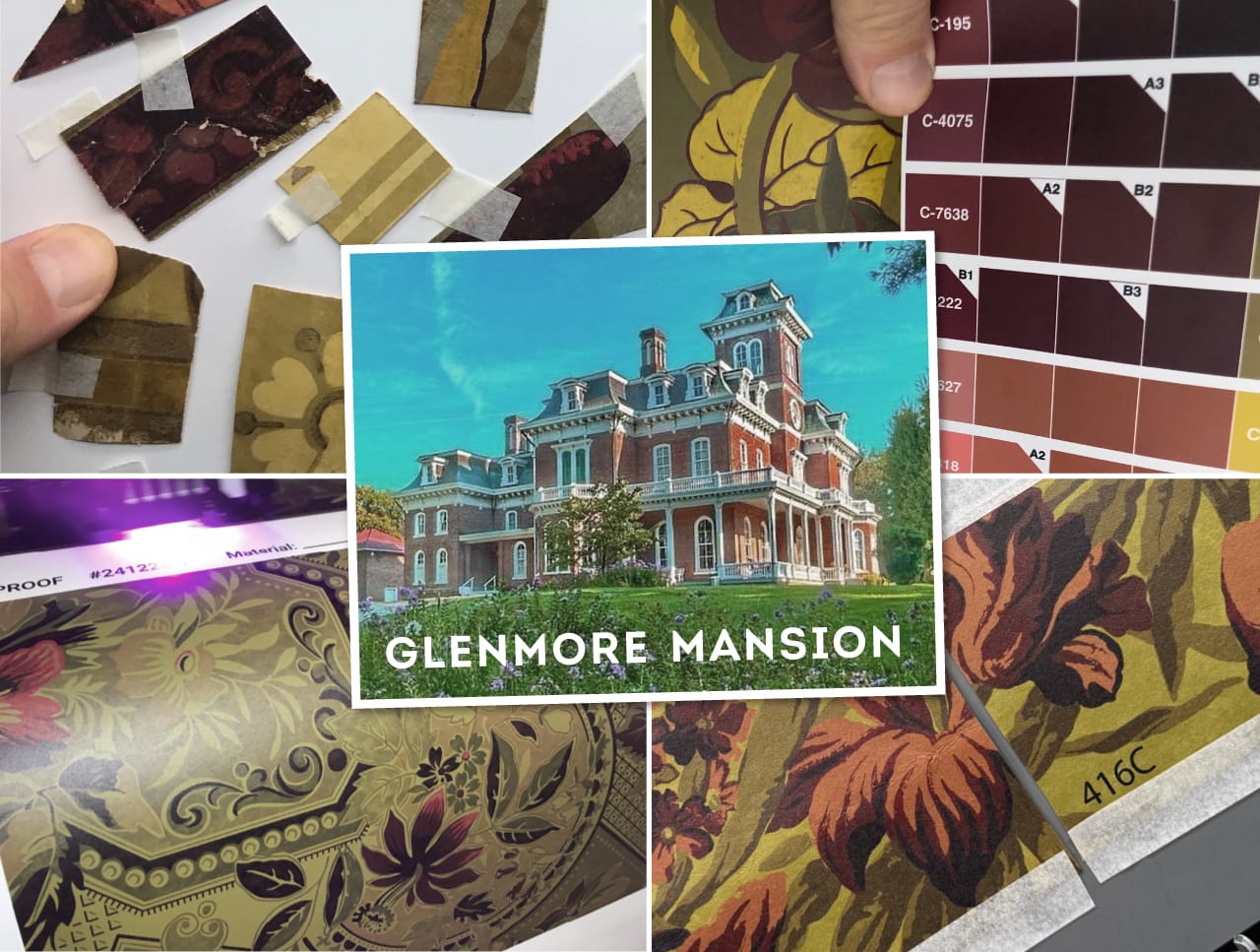
19th Century wallpaper almost always arrives in pieces, and the samples from Glenmore Mansion were no exception. They came out of their wrappings in fragments — soiled, scratched, unevenly faded, and in places missing altogether. These were four distinct papers from the front foyer of an 1868 Second Empire house museum in Jefferson County, Tennessee, each of them roughly 143 years old.
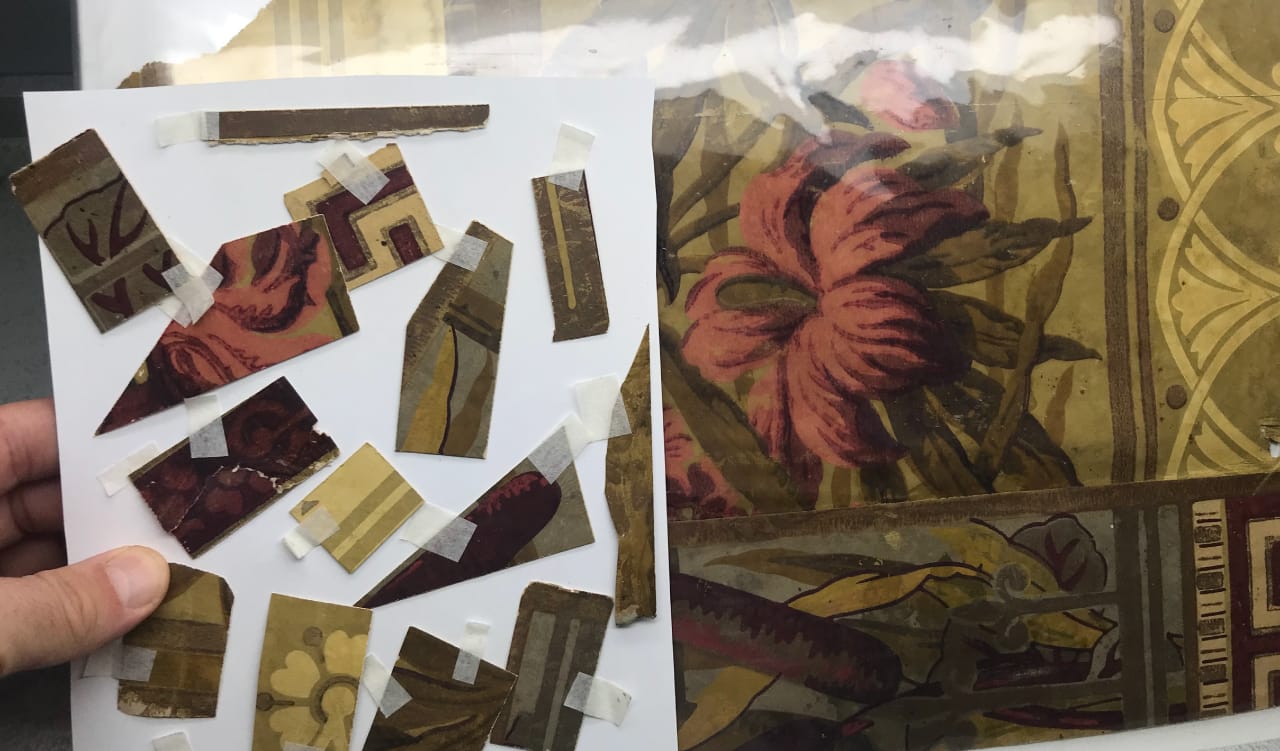
The four foyer papers as they arrived, soiled, torn and unevenly faded after 143 years.
Our first task was to map them out. We laid the fragments against the foyer’s wall and ceiling measurements and built a full schematic. What looked at a glance like a single wallpaper resolved into a coordinated scheme, built as one continuous design from the baseboard to the center of the ceiling. The ensemble featured:
- A lightning-bolt-and-floral field across the ceiling
- A floral border and matching corner panels framing it
- A geometric-and-floral paper on all four walls
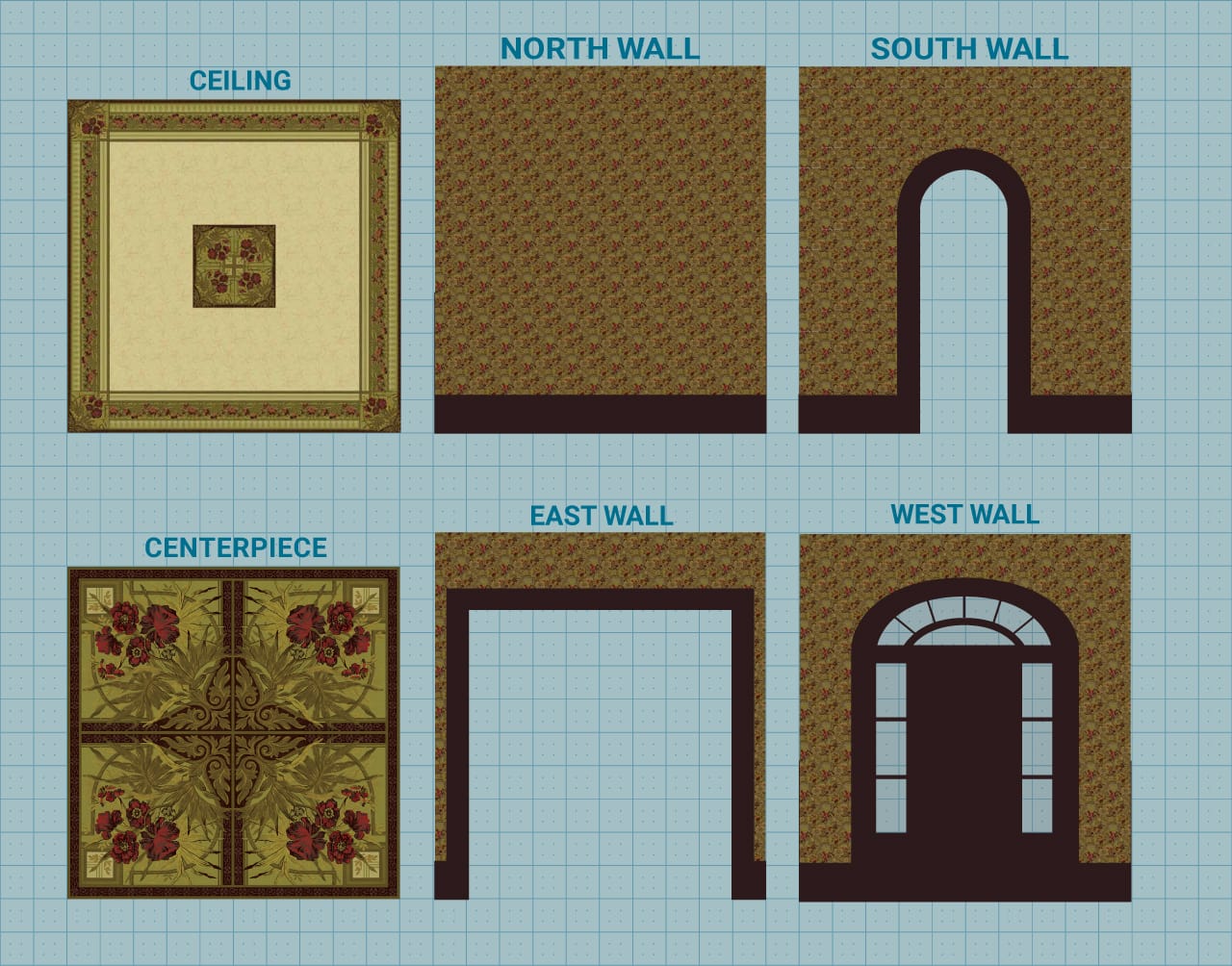
Mapped against the room’s measurements, the fragments resolved into one continuous scheme running from baseboard to ceiling center.
The Society, and a Careful Beginning
The Glenmore Preservation Society is an all-volunteer 501(c)(3) that has kept this twenty-seven-room mansion, listed on the National Register of Historic Places since 1973, open for tours, weddings, and events for roughly half a century. They reached out the ordinary way, with an inquiry and a set of samples, and it was during the estimate — studying the motifs and the condition of each fragment — that the full weight of the job came into focus.
The board had approached us with cautious optimism. An earlier effort to recreate the foyer had run close to two years without producing artwork they could print, and that long disappointment had left its mark. As we assessed the samples, the reason it had defeated their first vendor became clear.
Turning four damaged, incomplete papers into clean, print-ready files is a multiphase piece of digital work, the kind that takes several rounds of board feedback to get exactly right, and its hardest demand came from the pieces of the sample that were missing outright, whole sections of each design simply gone. That is precisely where the previous attempt had stalled, because rebuilding those absent pieces is an act of informed interpretation as much as technique.
We spoke plainly with the Board about how difficult the work would be and exactly how we would handle each part of it. That candor, and the confidence behind it, turned their caution into a commission. Then we answered two years of doubt the most direct way we could, by starting the reconstruction at once.
Reading the Repeat, and Rebuilding It
The wall pattern proved the most formidable of the four. It was set on a half-drop repeat, its elements arranged at unconventional angles, and significant portions of that structure were missing from the surviving fragments. Nowhere among the pieces was there a single intact unit to copy.
So we deduced it. Reading the implied angles and the fixed geometry the pattern obeyed wherever it did survive, we reconstructed how the design was meant to travel across the wall, then sketched the absent motifs back in by hand to sit correctly inside that recovered framework. We worked the same way across all four papers, and within three to four weeks every pattern was whole again. A board braced by experience for another long silence was floored to have finished artwork so soon.
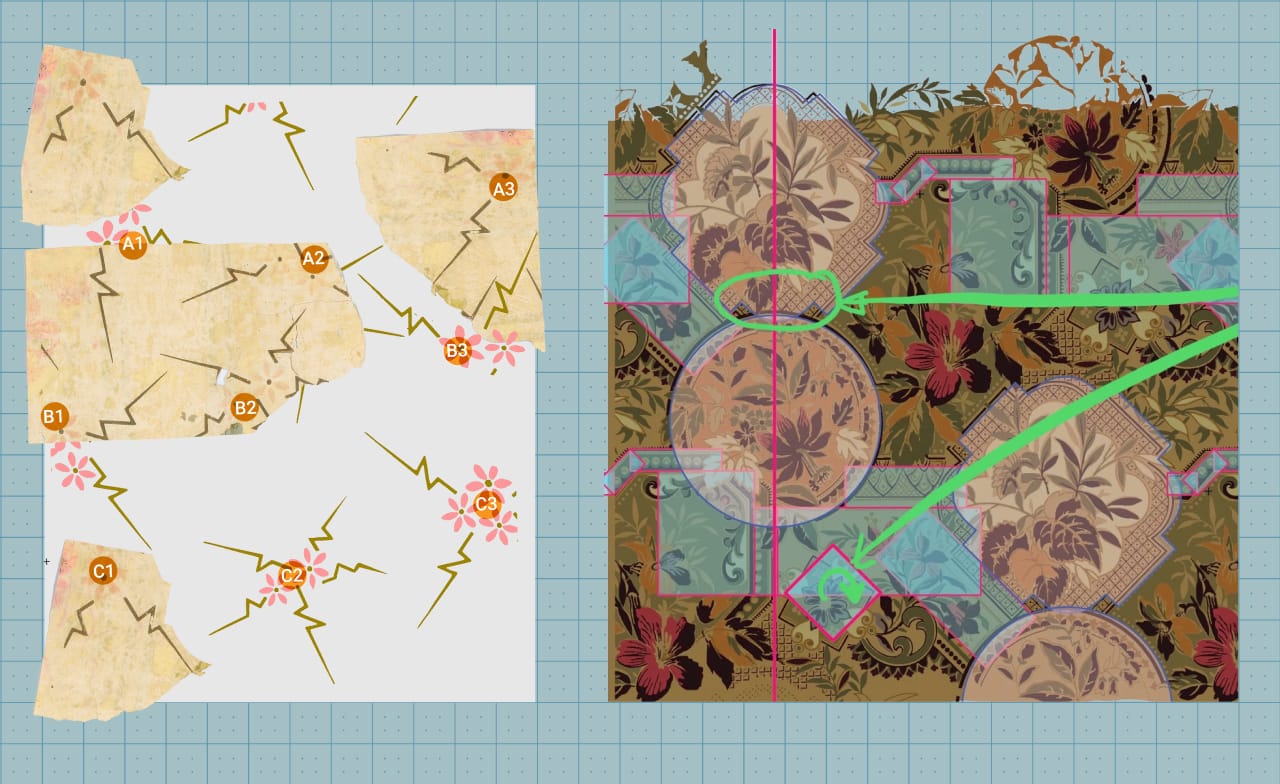
Not one intact repeat survived. The missing structure was deduced from the geometry the pattern obeyed wherever it did.
This is the work that an automated trace cannot do, and it is where the earlier attempt had almost certainly fallen apart. A scanner records what sits in front of it and has no means of recovering a motif that is no longer there. An AI doesn’t have the sensibility, accuracy, or historical training to generate it.
Restoring these lost motifs calls for an artist’s judgment and a working command of the period, so that a rebuilt element carries the intent of the original designer.
The Ceiling Medallion, Built From Four Corners
The centerpiece of the ceiling posed a problem of a different order.
No usable remnant of the medallion itself had survived — but the four corner motifs had. We built the centerpiece from those, each seventeen inches square, rotated inward and framed with a custom border drawn from the scheme’s own vocabulary, resolving the whole into a single medallion three feet on a side.
The real difficulty lay beneath the surface, in the joinery: every internal shape had to meet its neighbors precisely along each axis, so that a centerpiece assembled from four surviving corners would read as one cohesive design. With mathematical planning we were able to deliver just that as one solid, self-contained design.
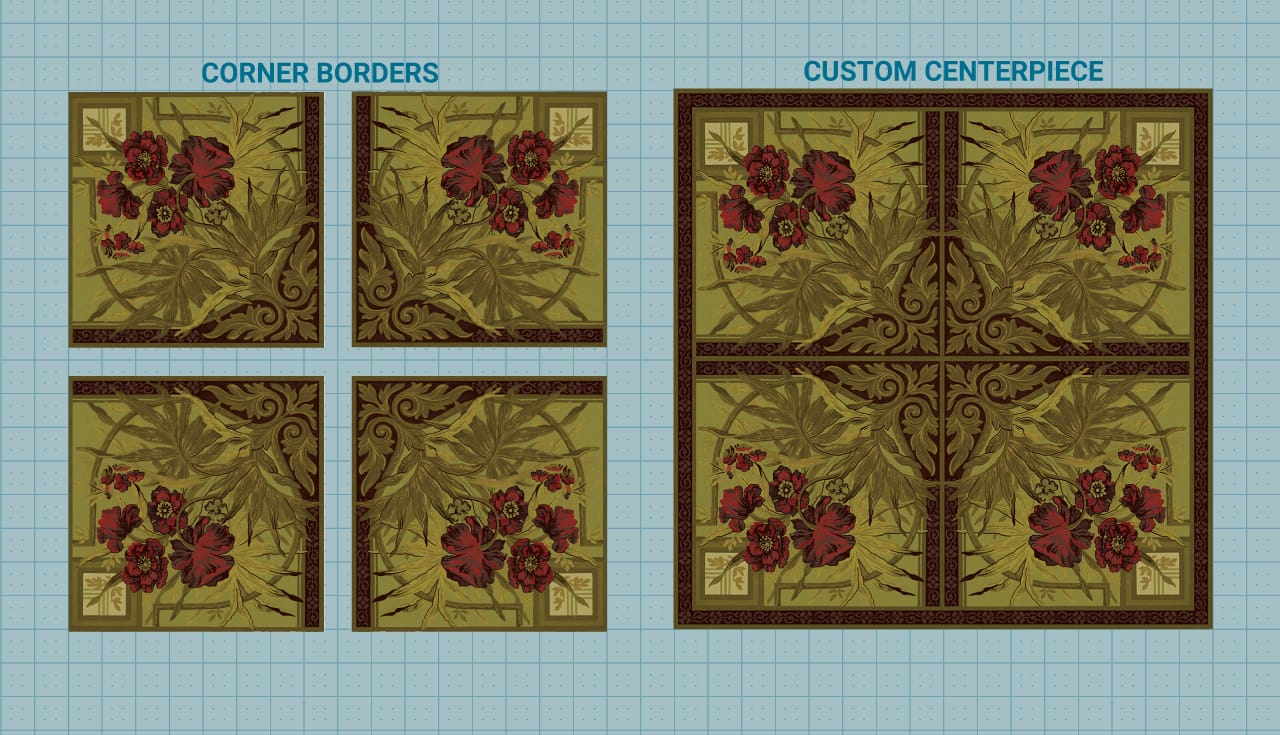
The medallion, three feet on a side, assembled from four surviving seventeen-inch corner motifs rotated inward.
Aging Digital Files for Authenticity
The reconstructed artwork came back clean, correct, and complete, and that proved to be the one thing the board did not want. Rendered as crisp vectors, the patterns looked too new and too digital for a room whose whole appeal is its age.
To solve this problem we scanned the surface texture of a period-appropriate paper, laid it over the motifs, and distressed the artwork by hand with a custom set of Photoshop brushes we have built up over years of this work. The result honored the character of the original — its grain, its softness, its warmth — while still presenting in mint condition, free of the soiling and tears the true survivors carried.
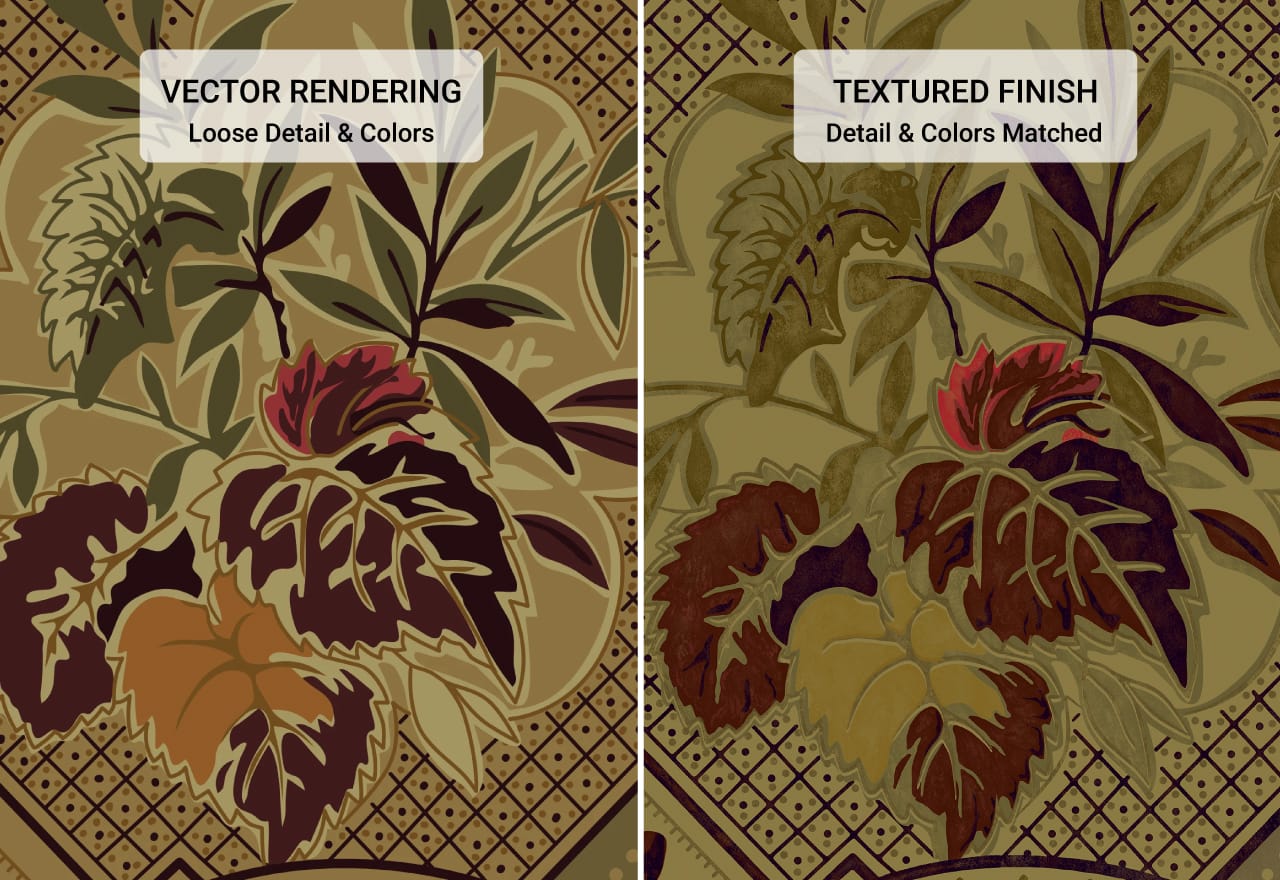
A scanned period paper texture and hand-applied distressing return the grain and warmth of the original, without the damage.
Judging how much age to leave in a room is among the most subjective calls in this craft. We settled it with the board, then carried that distressed finish across all four papers for a uniform look, as if they had all come from the same manufacturer and lot. With the artwork and texture locked, we turned to the greater challenge of color.
Matching the Faded Colors of an 1882 Scheme
Color matching is usually the most demanding phase of any recreation, and Glenmore asked more of us here than any project before it. Most jobs turn on one or two stubborn colors.
This one presented four separate papers, coordinated in palette yet each carrying its own difficult range: three colors in the ceiling pattern, nine in the wallpaper, eight in the border, and eleven in the corner panel. In total we identified more than thirty distinct hues across the scheme, some twenty of them genuinely hard to pin.
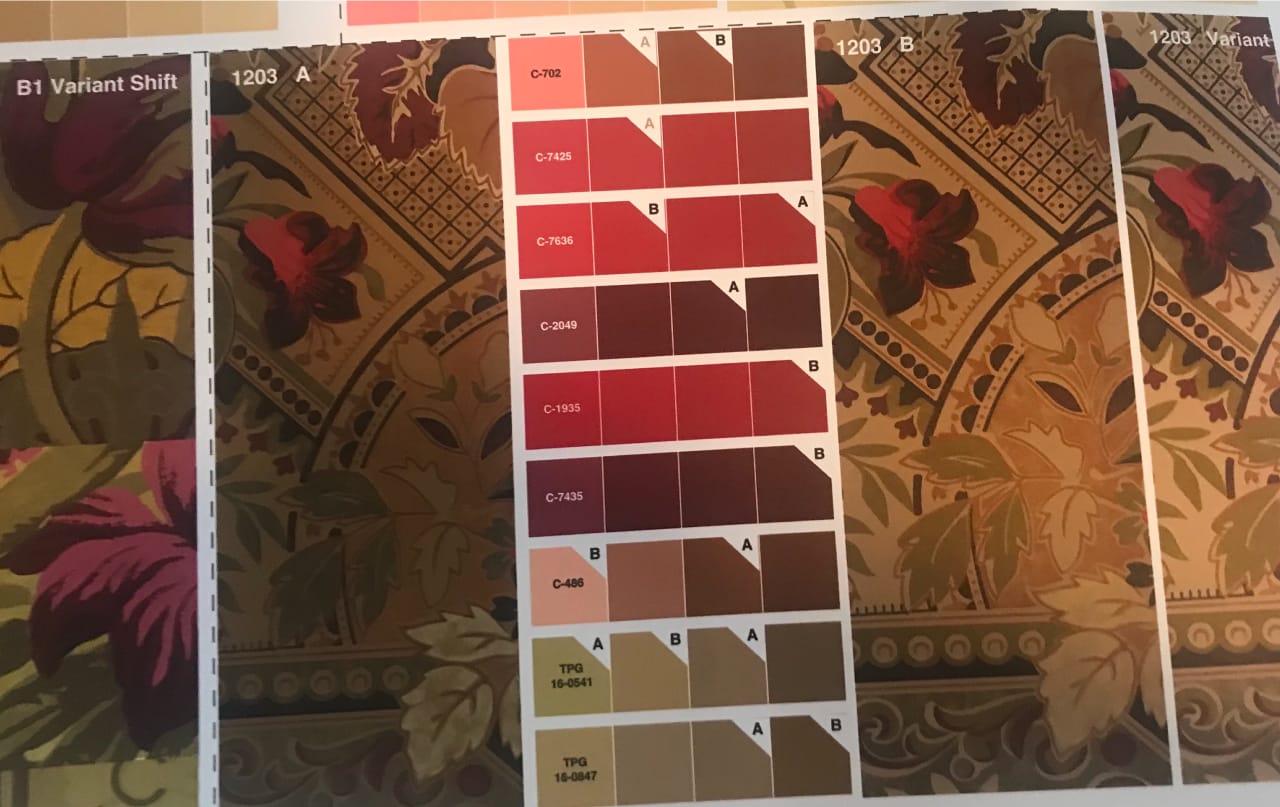
Every hue judged inside the motif against graded color chips, never on a screen.
We worked color in stages.
Each hue was first resolved on our internal color bars to set our direction, then printed into the actual motifs and judged in context, several rounds at each step — three to seven internal calibration prints per paper — before a single press proof left the studio.
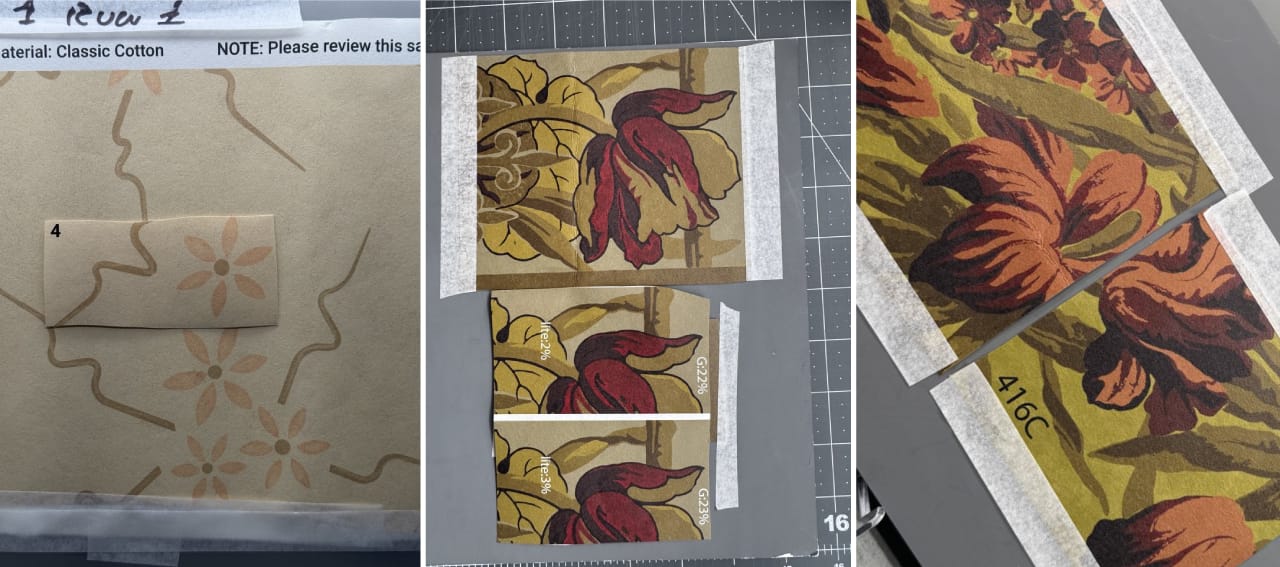
Internal calibration proofs on Classic Cotton, hand-annotated between rounds. Three to seven per paper before a press proof left the studio.
Everything ran on our four-color CMYK UV ink process, bracketed against our internal library of more than 20,000 catalogued hues. The fragments themselves complicated the target, since the original inks had faded unevenly; a single color could read three ways across one torn piece, leaving us to judge what it had been before more than a century of light and handling.
The greatest challenge came from the foyer’s overall chromatic range: creams, soft neutrals, and crimson reds. Even changing half a percent of ink presents dramatic shifts in colors like these. No recipe delivers them. It comes down to a carefully calibrated press and an eye trained over years to bridge the gap between digital inks and antique pigments, and instinctively know which way to push it.
With the color resolved, the digital reproduction was complete: a full set of print-ready files. Producing that artwork is a manufacturing process of its own, distinct from the printing that turns it into paper.
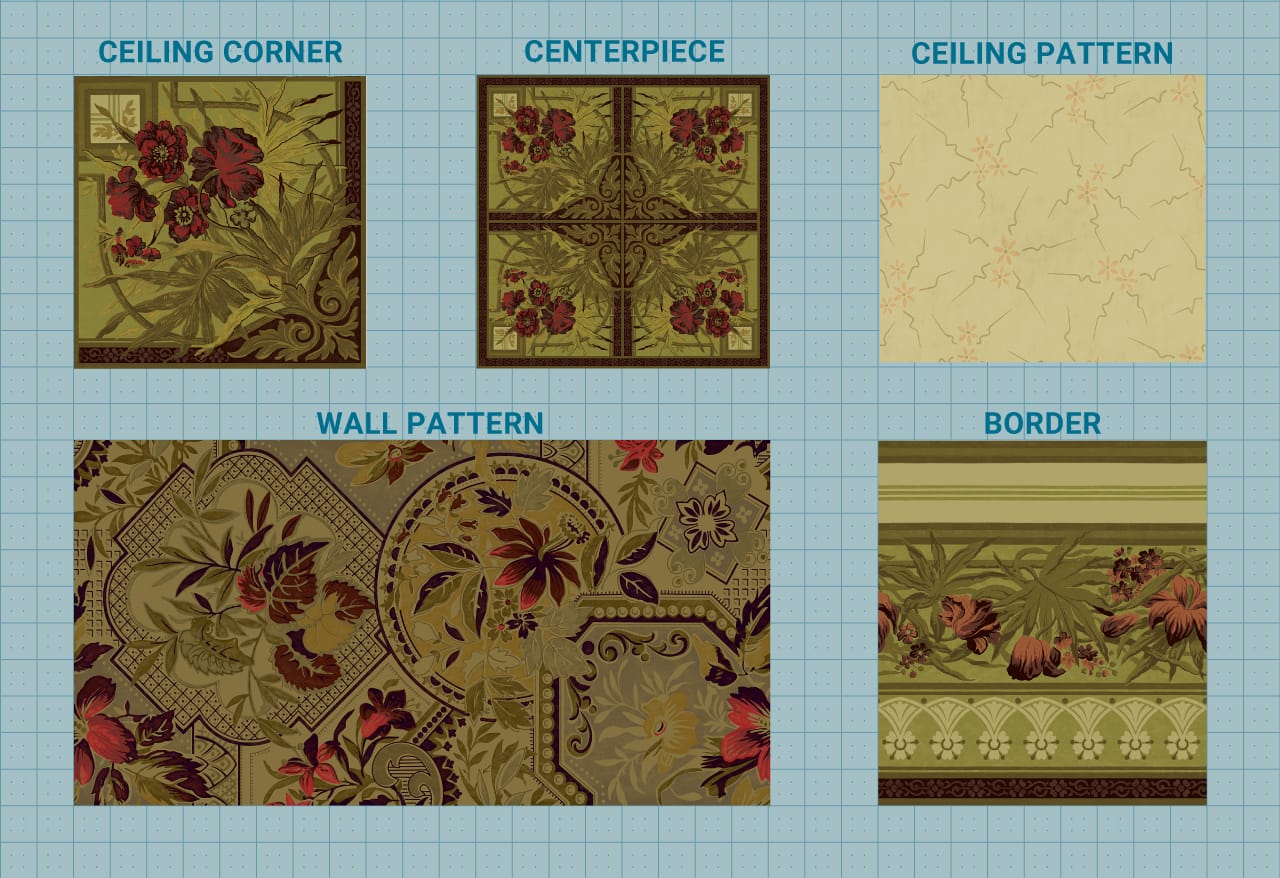
The digital deliverable: ceiling, border, corner panel, wall pattern and medallion, all print-ready.
Proofing, and Mapping It to the Room
We printed strike-off proofs on the actual production material, so that color, scale, and texture could be judged in the hand rather than trusted to a screen. The scheme moved through the board proof by proof — three rounds on the wall paper, two on the ceiling, two on the border, three on the corner panel — each pass carrying a small color correction and, as often, a note on the aging.
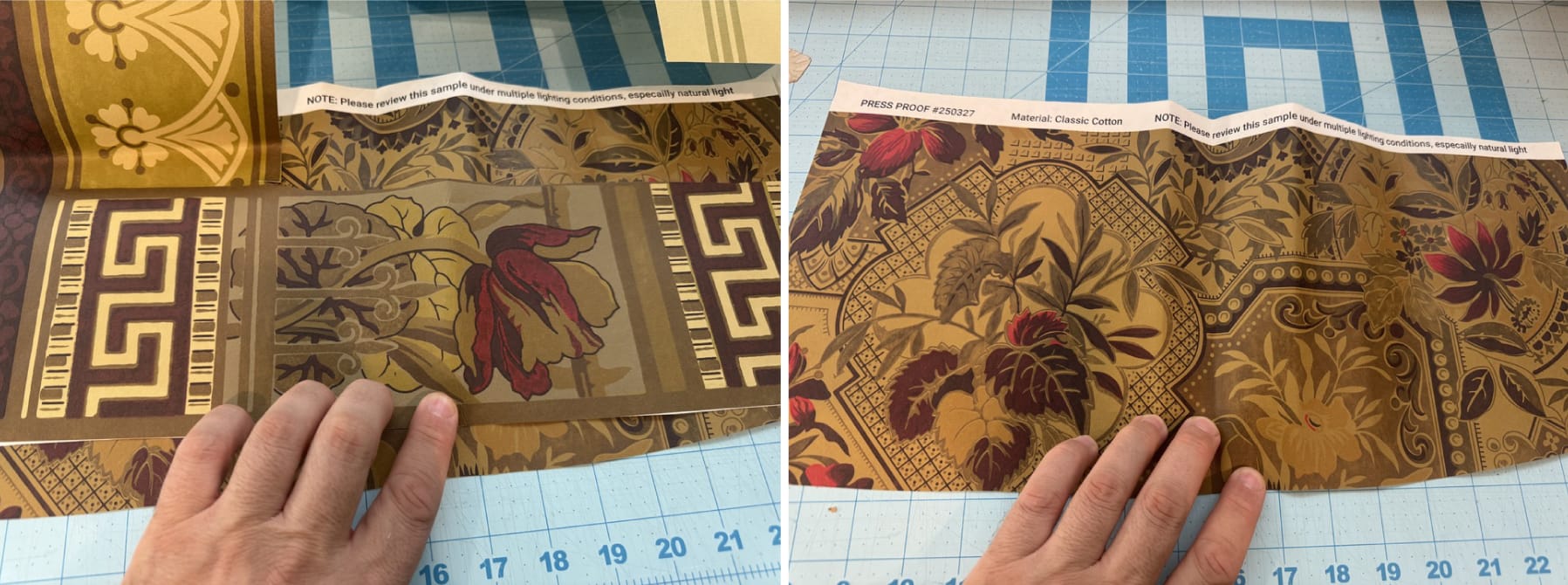
Strike-off proofs on the actual production material, checked by hand against the original fragments.
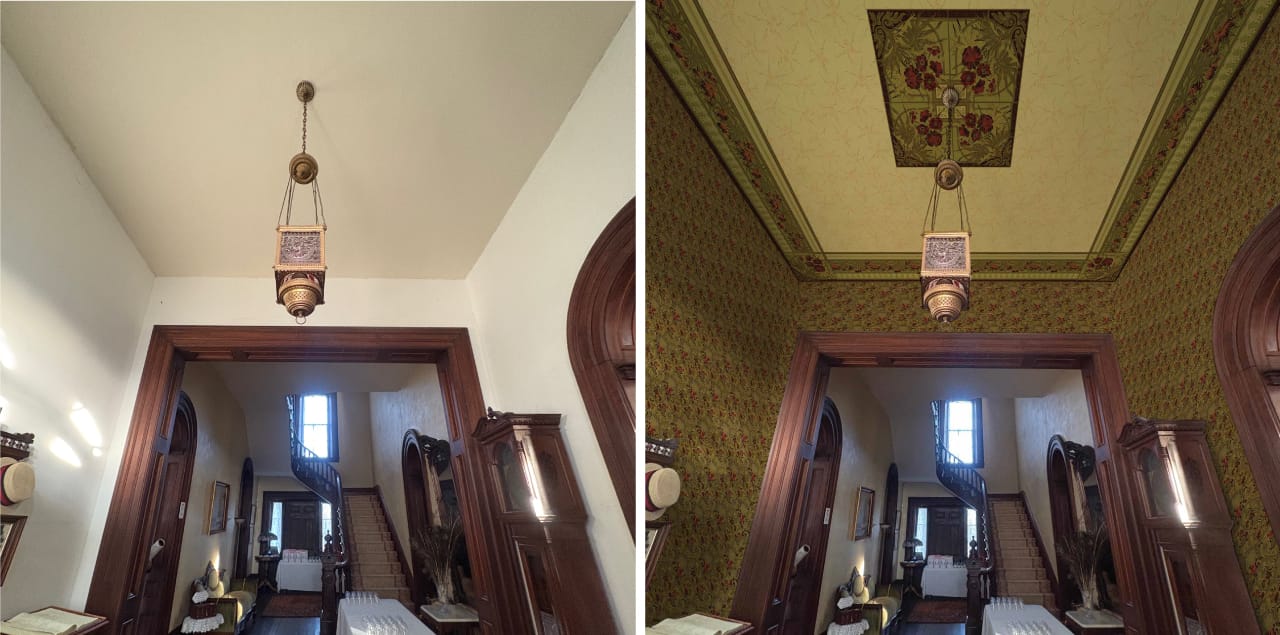
We also built full mockups that set the approved patterns into photographs of their own foyer, the entrance, the ceiling, and the doorway, so ten volunteers could stand in the finished room before a single production sheet existed.
Years of this work had taught us that seeing a pattern in its intended place, at its intended scale, is what turns a board’s cautious hope into a confident yes. Together with the design options we gave them to vote on, those mockups carried the decision, and when the finished proofs went to a full vote, the board approved them without a dissent.
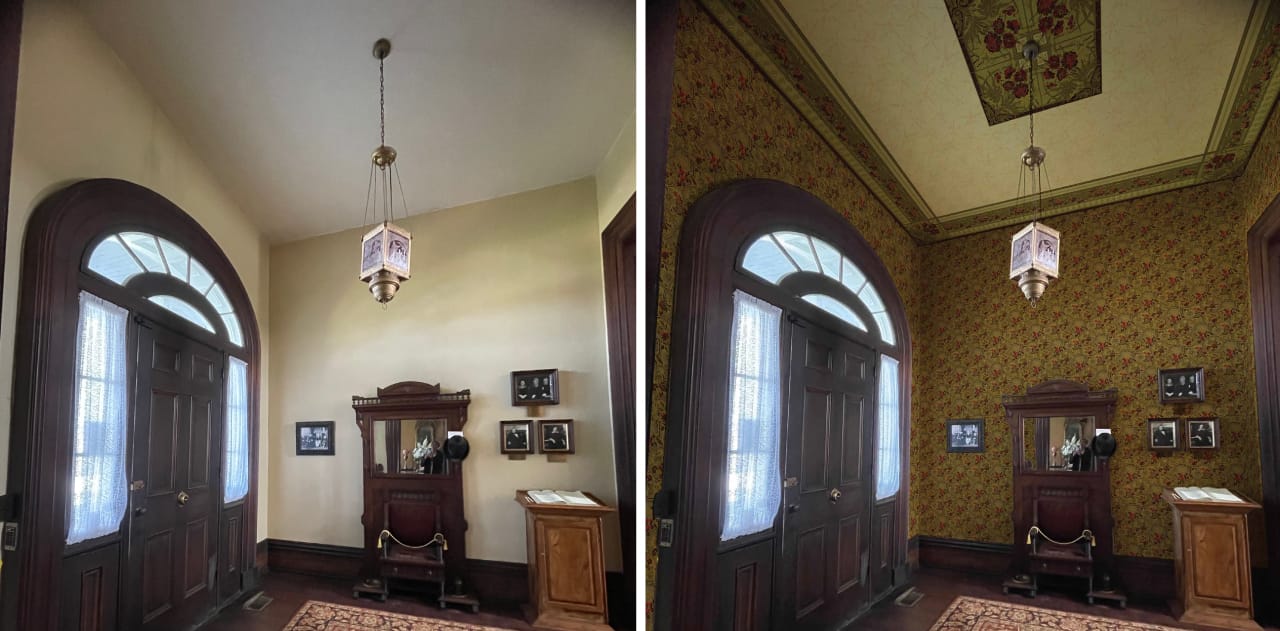
The entrance, before and after. Mockups let ten volunteers stand in the finished room before a single sheet was printed.
Everyone, Rob reported afterward, was “very impressed with your restoration of our 143-year-old wallpaper samples,” and there was “lots of excitement in the room.”
“In my opinion, the samples look stunning. Your team are incredible artisans, and I thank them for their talent, training, and hard work.”
— Rob Beuch, President (at project start), Glenmore Preservation Society
“Wow, this looks great — your speedy work and good communication are much appreciated.”
— Bob Jarnagin, Board Member & Jefferson County Historian
Choosing the Material, With the Installer
Producing the artwork is our responsibility. Getting it safely onto a wall a century and a half old is a shared one, and it began with the museum’s installer, Annalee Bohon, inspecting the site. Examining how the foyer was built, she flagged the concern that mattered most: the room carries real humidity, and one of its walls faces the exterior, with different thermal behavior than the interior three. A non-breathable vinyl, the early candidate, could trap moisture against that old plaster.
We worked the problem through with her and settled on a breathable non-woven substrate, a Classic Cotton stock, and proofed the final scheme on it. We are candid about what the finished paper is: a modern, digitally printed reproduction on a modern material. It is not a hand-blocked archival paper, and we would never present it as one.
For a working house museum that needs the room to read correctly to its period while receiving visitors the year round, a stable, breathable non-woven substrate is the sound choice for old plaster, and saying so plainly is part of how we earn a client’s confidence. Our role carries a clear boundary as well: we recreate and print the paper, and the hanging belongs to the installer.
From there, the work passed from our hands to theirs. Over the weeks that followed, Annalee and the museum’s artisans hung the finished papers — the wall covering, the border, the corner blocks, and the medallion at the center of the fourteen-foot ceiling — and for the first time in generations the foyer read as one unified scheme, the way Agnes Watkins Jarnagin, wife of the mansion’s second owner, had chosen it well over a century before, in the exuberant Aesthetic taste of the 1880s.
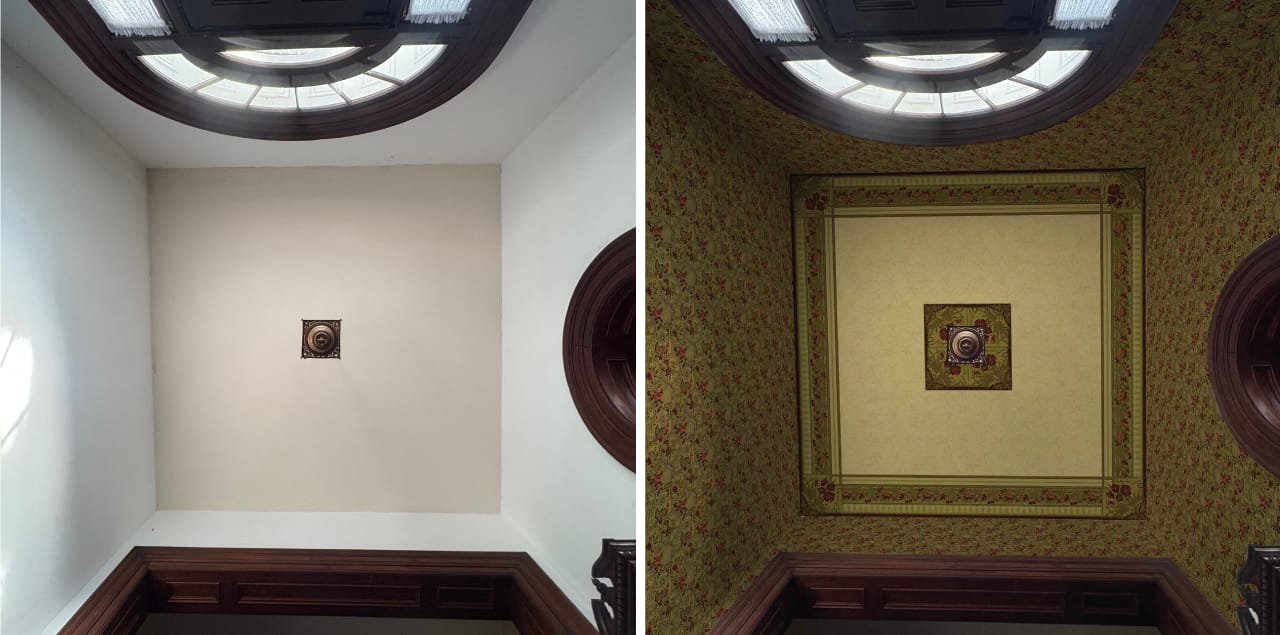
The fourteen-foot ceiling, with the reconstructed medallion, border and field in place.
In the spring of 2025, the restored foyer was unveiled to the public, and it now opens every tour of the house. Jefferson County’s newspaper, the Standard Banner, marked the occasion with a featured article of its own.
The doorway, where the wall and ceiling papers meet.
Reprinting Historic Wallpaper: The One-Year Reorder
Roughly a year later, the Society called to ask us to print more of the patterns we had rebuilt — the same foyer motifs for the upstairs room, roughly 1,500 square feet, adjusted to that room’s own dimensions, with fifty percent extra material set aside against future damage.
Our press had drifted in the intervening months, as presses do. We had kept every version of the job archived for precisely this reason, and rather than trust the original files to reprint identically, we ran fresh color tests and re-matched the palette internally before sending a press sample for the board’s review. They approved it, and we printed the run.
“All of us feel fortunate to have developed such a strong relationship between New York and our little area of Tennessee.”
— Bridget Call, President, Glenmore Preservation Society
Questions We Hear From House Museums and Preservation Boards
Can you reproduce wallpaper from damaged or incomplete samples?
Yes. Missing sections are the heart of what we do. We reconstruct the absent portions of a motif by reading the pattern’s underlying geometry and its period design language, rebuilding lost elements to match the original designer’s hand.
Can you match the original colors of a faded pattern?
Yes, within the honest limits of the medium. We resolve every color on our four-color CMYK UV process, bracketing against our internal library of more than 20,000 catalogued hues and running multiple calibration proofs, and we can set the finish anywhere from freshly printed and crisp to a lightly aged, period-accurate patina.
Do you install the wallpaper?
No. We recreate and print; your own installer or conservator hangs the finished paper. We provide the artwork, the color, and any layout guidance the installer needs.
Recreate Your Own Historic Wallpaper
If you steward a landmark, a house museum, or a period home with a pattern that is fading, damaged, or long out of print, we can rebuild it from a physical fragment or even a photograph, using the same historic wallpaper reproduction process we brought to Glenmore. Send us a photo or a sample, even a phone shot in poor light, and we will give you a straight, honest read on what can be recovered.